

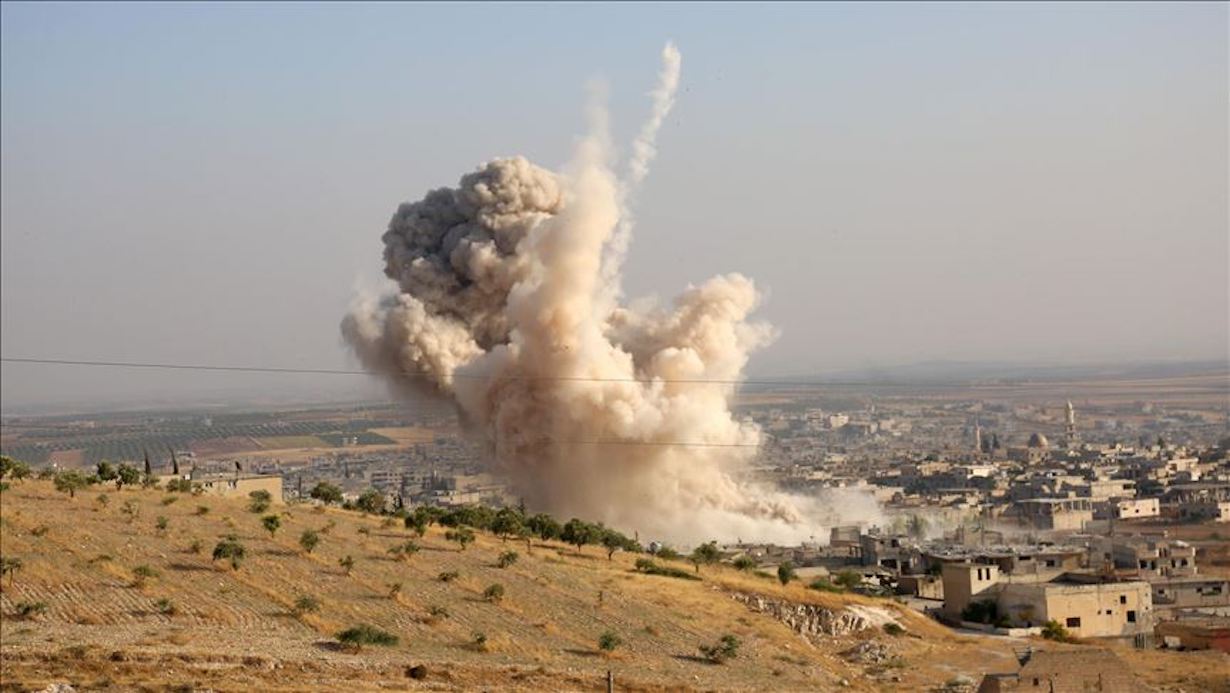
Over the last week, the Syrian Arab Army (SAA) and its allies have continued their push in the Greater Idlib Region, making incursions into Opposition-held territory in northern Hama and southern Idlib. The advances represent some of the most significant advancements by either side since fighting broke out in April.
Among the key areas currently under intense bombardment is the town of Khan Sheikhoun, which is infamous for the chemical attack that took place in April 2017. The town is controlled by a variety of Opposition groups, most prominent among them the National Front for Liberation (NFL), Jaish al-Izza and Hayy’at Tahrir al-Sham (HTS). The capture of Khan Sheikhoun by the SAA, which is expected to take place in the coming days, would hand the Syrian Government greater foothold on the Damascus – Aleppo M5 highway. Moreover, control of the key town would provide the SAA with a launch pad from which it could instigate a future push towards the city of Ma’arat al-Nu’man, known in Opposition circles for its vehement civic opposition to the Government.
The latest offensive in southern Idlib has taken place despite the SAA previously announcing that it would wait until Wednesday 14th August, the end of Eid al-Adha, for rebel and militant groups to withdraw from the Idlib de-militarised zone (DMZ), which was re-negotiated two weeks ago as part of the 13th round of the Syria Peace Talks in Nur-Sultan (Astana). Despite these negotiations, and a short lull in fighting on Monday, the SAA continued its advance into the region unabated. If the SAA is successful in capturing Khan Sheikhoun over the coming days, its encirclement of the town of Morek and its nearby observation post maintained by the Turkish Armed Forces (TSK), could have far reaching implications.
Indeed, on Monday reports emerged of a TSK convoy travelling through Ma’arat al-Nu’man towards Morek, which would suggest that the TSK has reinforced its observation point over the past few days and has no plans to withdraw. Although Turkey has remained relatively silent throughout the SAA’s advance on Khan Sheikhoun, its reluctance to withdraw its forces could suggest that it views its military presence in Idlib as permanent regardless of the successful implementation of the DMZ.
Despite Turkey’s silence over the SAA’s advance, the international community’s response has raised concern with the humanitarian impact of a SAA-led advance in Greater Idlib, which is home to more than three-million people. Towards the end of last week, the United Nations’ Humanitarian Chief for Syria, Panos Moumtzis, warned that the escalating violence is “playing with fire” and highlighted that more than 500 civilians have been killed since the start of the SAA’s operations in late April. This figure includes the deaths of 25 people killed in the region since August 2nd, according to the Syrian Response Coordinators.
The collapse of last week’s ceasefire is symptomatic of the wider inability or reluctance for the Astana guarantor countries to take greater responsibility for the implementation of agreements made as part of the Astana format. Furthermore, the Syrian Government has maintained an ambiguous stance towards the implementation of the DMZ, which it regarded as an attack on Syrian sovereignty following the Sochi Summit last September. Damascus has also become increasingly vocal against Ankara over the support of “terrorist groups” in Idlib. It is therefore likely that the SAA is willing to absorb the heavy losses that it has endured in the Greater Idlib Region to force Ankara, as well as groups based in Idlib, to negotiate from a much weaker position.
The situation is further complicated by Ankara’s ambiguous and quiet stance on Idlib, which has led to accusations among the Opposition of the Turkish President, Recep Tayyip Erdoğan, “selling out” the Khan Sheikhoun region. The NFL spokesperson, Naji Mustafa, has sought to allay these fears. A number of factions belonging to the Turkish-backed Syrian National Army (SNA) have also indicated that they are preparing to move to Idlib. Despite these developments, the TSK’s inaction over the SAA’s advance and the relative silence from the Ankara suggests that the Turkish Government is not willing to directly engage the SAA for the purpose of maintaining the DMZ boundaries. As a result, the SAA likely views the capture of Khan Sheikhoun as a test for a further push into Greater Idlib. If the guarantor countries, Russia, Turkey and Iran, are really looking to reduce the fighting in the region, they will need to revisit the DMZ agreement and explore the means for its implementation. Otherwise the fighting in Greater Idlib is unlikely to subside anytime soon.