

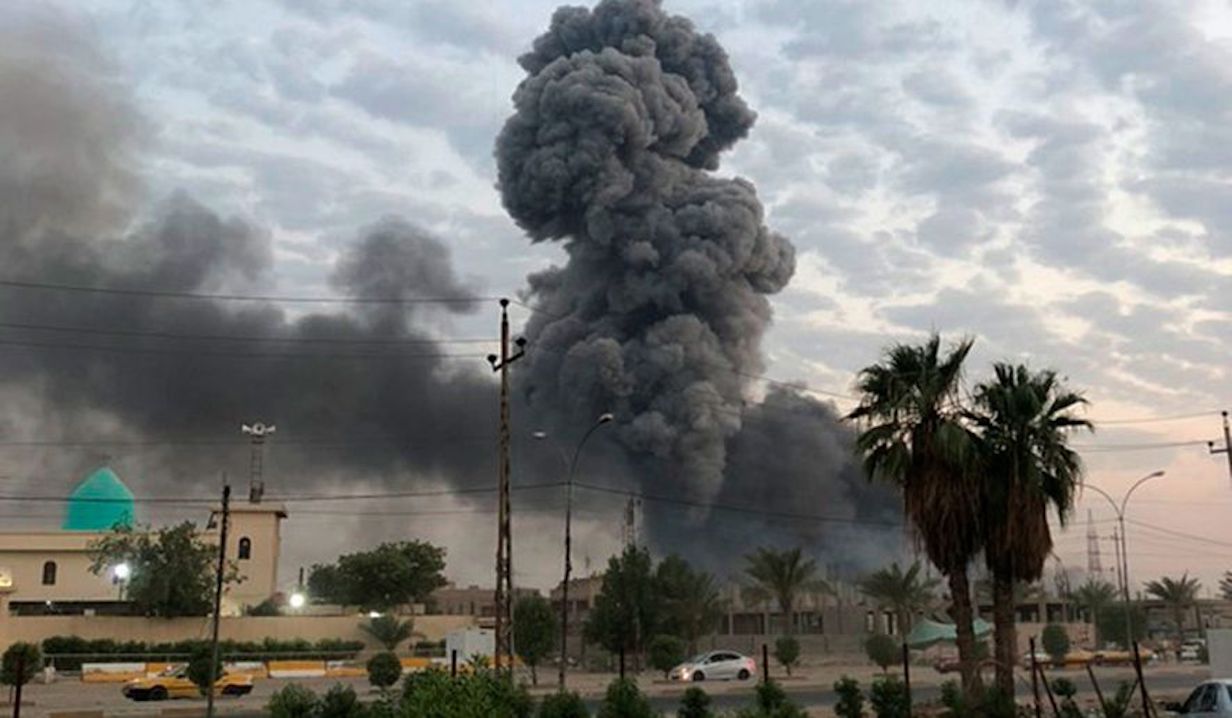
Since mid-July, a series of drone strikes, allegedly conducted by Israel, have targeted the bases and weapons depots belonging to some of the Iranian-backed factions of the Iraqi Popular Mobilisation Units (PMU). On Sunday, a drone strike at an outpost held by the PMU’s 45th Brigade near al-Qaim close to the Syrian Border left two fighters dead, one being a commander named Abu Ali al-Dabbi. Last week also saw a strike carried out near the Balad Air Base, which hosts a number of different Iraqi and PMU units, in addition to United States’ forces and contractors. An additional fire at a PMU-operated weapons depot in southern Baghdad’s Camp Sakar, the week before, led to the death of one civilian and wounded 29 people. As the cause of these incidents has not been officially determined, the Iraqi Government and the PMU are currently investigating these incidents to assess whether Israel was involved.
In an immediate response to the uptick in drone strikes, the deputy chairman of the PMU, Abu Mahdi al-Muhandis, accused the US of being complicit with the alleged Israeli strikes and providing air cover for the drones to operate over Iraqi territory. Responding to the accusation on Tuesday, the deputy commander of the US-led Combined Joint Task Force, Christopher Ghika, stated that these accusations are “false” and that the International Coalition is ready to defend itself if any attacks against it were to take place.
Across Iraq, reactions to the drone strikes have been mixed, with the Fatah Coalition, which includes several PMU-affiliated parties, doubling-down on its accusation of Israeli involvement and US complicity. Several Fatah MPs have called for the hastened withdrawal of all US forces in Iraq and said that they will discuss this issue when the Parliamentary session resumes. However, a number of leading Iraqi politicians, including the leader of the Sai’roun Alliance, Muqtada al-Sadr, have responded by increasing calls for the PMU to further integrate into the Iraqi Security Forces (ISF) and hand over all weapons depots to the government. Nevertheless, in a show of support for the PMU, Iraqi President Barham Salih, Prime Minister Adil Abd al-Mahdi and Speaker of Parliament Mohammed al-Halbousi met with several PMU leaders and agreed that the recent attack on al-Qaim was an attack on Iraqi Sovereignty and reiterated their support for the security forces fighting the Islamic State (IS) in the country.
Although Israeli Government officials, for their part, have largely remained silent over the attacks, Israeli Prime Minister Benjamin Netanyahu last week hinted at Israeli involvement in the drone strikes, stating that Israel would “act against Iran wherever necessary”. The unprecedented attacks against Iraq have taken place as Netanyahu prepares for snap legislature elections next month following failed negotiations to form a new coalition government. Accordingly, the suspected Israeli attacks could represent a political maneuver on behalf of Netanyahu, who is keen to display his anti-Iran and “Mr Security” credentials prior to the vote.
Nevertheless, Israel’s alleged shift in tactics by extending its attacks against Iranian targets into Iraq, as well as across Syria and Lebanon, could have far-reaching consequences. Unlike the Syrian Government, the Iraqi Government has attempted to balance its relations between Iran and the US following the formal defeat of the IS in the country. As such, US forces present in the country regularly fight and train alongside the PMU. Indeed, US forces were present in the Balad Air Base at the time of the drone strike. According to some observers this could have the provided the PMU with a potential near-enemy with which it could seek retribution against Israel.
While US-Israeli relations are unlikely to suffer, it could reduce Washington’s room to maneuver in Iraq and prove detrimental to its efforts to gain greater economic and political leverage over Iraq at the expense of Iran, which has continued to trade with Iraq despite US sanctions. If attacks against Iranian-backed groups continue, it could lead to tit-for-tat incidents, risking Iraq getting caught in the crossfire at a time it is trying to recover from the devastating impacts of the war against the IS. This scenario is especially pertinent in the aftermath of similar strikes in Lebanon against Hezbollah. Hostile rhetoric between Lebanon and Israel has picked up significantly since, and the tensions along the two countries’ borders rose significantly, leading to fears of a repetition of the 2006 war.
To avoid this, the Iraqi Government must ensure that its response to these attacks – if they are proven to have been conducted by Israel – is a calculated and diplomatic one. This sentiment was stated by the Iraqi Ministry of Foreign Affairs, who said they will take the issue of Iraqi sovereignty infringement to regional and international organisations including the UN Security Council. In addition, the Chairman of the PMU, Falih al-Fayyadh, has issued several statements in an attempt to de-escalate tensions and avoid dragging Iraq into a proxy war, a sentiment that several high-ranking Iraqi officials have also reiterated.
For more information on this subject and other developments in Iraq, subscribe to our daily intelligence reports and weekly digests.