

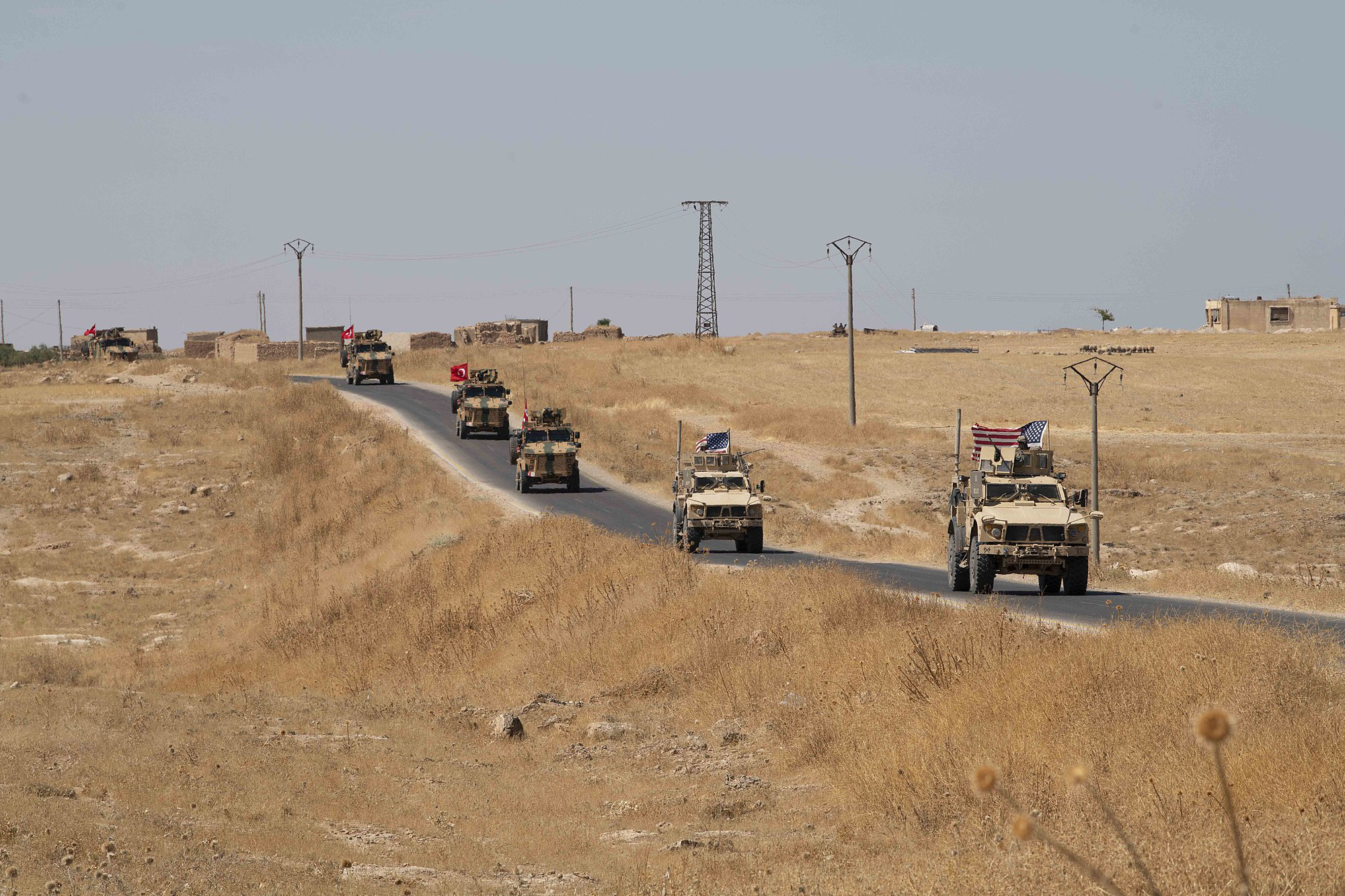
Turkish President Recep Tayyip Erdogan recently announced that the Turkish Armed Forces (TSK) are preparing another military intervention in northern Syria, with the stipulated aim to create a 30-km “safe zone”. What is the purpose of this “safe zone” and why are these plans coming to fruition now?
Background
Unilateral military interventions by Turkey, which have been absent since Northern Cyprus in the 1970s, have now become a frequent feature in its foreign policy towards Syria. Since 2015, Erdogan, whose ruling AKP had lost its majority in the elections, has expressed intent to create the 30-km “safe zone” in the north of Syria. The stated attempt is to prevent the formation of a Kurdish-majority state run by Democratic Federation of Northern Syria, now named the Autonomous Administration of North and East Syria (AANES). Ankara regards AANES as a political extension of the Kurdistan Workers’ Party (PKK), long regarded by the Turkish state as a threat to its territorial integrity due to its goal of creating a Kurdish state. A number of military operations were conducted between 2016 and 2020 in attempts to create the aforementioned “safe zone”. A watershed moment in this regard was Operation Euphrates Shield, launched in August 2016, which paved the way for Turkey’s direct interventions inside de jure Syrian territory. However, up until this point, those operations have led to the occupation of only certain pockets of territories in northern Syria, in tandem with Syrian rebel forces on the ground.
What is the Purpose of the “Safe Zone”?
Ankara’s primary stated aim in the creation of the “safe zone” is to prevent “terrorists” from conducting any attacks in Turkey. The predominant military force currently present in the north and east of Syria is the Kurdish-dominated Syrian Democratic Forces (SDF), with the primary faction being the People’s Defence Units (YPG), a group ideologically related to the PKK in Turkey. Kurdish separatism has been a concern of the Turkish state since its establishment and have been further amplified since the formation of the PKK in the 1980s. Cross-border interactions between Kurds (and other ethnic groups) in Turkey and Syria led to the formation of a common political culture among significant parts of these populations. As a result, numerous political and military forces, including Kurdish-dominated forces, emerged in the aftermath of Damascus losing authority in these regions since 2011. Turkey’s stated concerns are thus primarily political and ideological as it is wary of the political programme propagated by the aforementioned groups taking hold within Turkey.
Prior to the war in Syria, Damascus and Ankara regulated their mutual concerns regarding the Kurdish issue through the 1998 Adana Agreement, which aimed to uproot pro-PKK Kurdish political activism in Syria. However, the political disarray in Syria led to a perception in Ankara that Damascus was no longer capable of enforcing the agreement. As a result, Turkish officials cited unilateral actions as their main option. A similar pattern has also emerged regarding Turkish military operations in northern Iraq, where PKK elements have based themselves. Turkey has recently increased its aerial airstrikes on the PKK, as well as its efforts to get Baghdad to align with its goals.
Why Now?
With Ankara’s plan to create a 30km “safe zone” already in the works over the past years, the TSK has already been undertaking some of the more practical steps towards its objectives. However, such steps have slowed down and even outright paused over the past two years, suggesting that Ankara was done with military interventions. So, why is Erdogan now calling for renewed operations?
One reason is that shifts in the geopolitical map have aligned in such a way that Ankara feels more at ease launching another cross-border intervention. Perhaps most significantly, Russia’s own cross-border military operation in Ukraine has played a role in this shift. One of the main obstacles to Ankara’s wishes to go ahead with another military intervention in northern Syria has been Russia’s opposition to a further Turkish push into Syrian territory.
However, with the severing of diplomatic ties between several Western countries and Russia, as well as the Western sanctions on Russia, Moscow is keen to maintain its diplomatic relations with countries that have retained relations. Although Turkish-Russian relations have experienced bouts of tensions over the course of the Syrian war, Moscow is now demonstrating greater willingness to take Ankara’s interests into account. Early in June, Russia’s Ministry of Foreign Affairs spokesperson, Maria Zakharova, expressed Russia’s opposition to Turkey’s military plans in northern Syria. However, only a week later, Russian Foreign Minister, Sergei Lavrov, stated that Russia “fully understands” Turkey’s concerns.
Another related development is Sweden and Finland’s proposed accession to NATO. Turkey is currently vehemently opposed to their accession, in particular that of Sweden’s. In recent years, Sweden accepted refugees from Turkey with sympathies towards, or expressing outright support for, the PKK and YPG. NATO Secretary-General Jens Stoltenberg has recently stated that Turkey’s concerns are “legitimate”, providing Turkey with further room to pursue its ambitions in northern Syria in the knowledge that NATO will not directly oppose those plans. In sum, Russia’s actions in Ukraine have increased Turkey’s geopolitical capital and bargaining chips both vis-à-vis Russia and NATO, allowing Turkey to take further unilateral action in Syria at this juncture.
Finally, perhaps the most significant internal reason that is pushing Ankara to take this step is the growing domestic political resentment in relation to the currency and debt crisis and increasing anti-refugee views. Although the two issues are not directly related, opposition forces are capitalising on general discontent and linking both issues in their accusations directed at the current government. Erdogan has consequently asserted that the proposed “safe zone” will accommodate a million Syrians who have sought refuge in Turkey. He added that their return will be “voluntary”, despite several accounts in recent years demonstrating that Syrian refugees have already been forcibly deported to other parts of northern Syria that have already been occupied by Turkey. Such domestic dissatisfaction has already led to AKP losing Ankara and Istanbul in 2019 local elections. Recent opinion polls point to the AKP haemorrhaging support, which bodes badly for the general elections in June 2023. With 2023 also being the centennial of Turkey’s founding, the timing of these renewed military operations appears, at least partially, to be related to the AKP’s need to maintain domestic legitimacy.
Possible Repercussions
Although the geopolitical winds are currently favouring Ankara, there are serious potential risks involved with a renewed military operation in northern Syria.
Firstly, in terms of potential geopolitical consequences, Turkey’s proposed military operation has met sustained criticism from the US and Iran. Washington has supported the SDF in their fight against the Islamic State (IS), something that already strained ties with Ankara. Although former US President Donald Trump ordered the withdrawal of US troops in northern Syria in 2020, a contingent has remained in the region and it continues to provide the SDF with support. American officials have warned that the Turkish intervention will lead to an emboldening of the IS in the region. Indeed, the IS prison outbreaks that took place earlier this year are testament to the threat that the group continues to pose. Although the US has previously attempted to prevent direct Turkish interventions into northern Syria, they have thus far failed to stop them, at best limiting Turkish-led advances and sending signals to Ankara through economic sanctions. The US’ partial withdrawal initiated in 2020, along with American reluctance to further deepen already tense diplomatic tensions with Turkey, will likely limit the US’ response to Turkey’s military operation to somewhat innocuous public criticisms.
Iran, on its part, has categorically expressed its opposition to the military operation. Iran and Turkey have thus far avoided direct confrontation in Syria; however, the villages of Zahra and Nubl will fall within the scope of Turkey’s proposed “safe zone”. These two villages have gained significant strategic importance for Damascus and pro-Shiite forces from Iran, Iraq and Lebanese, who have supported local forces against Sunni rebel groups throughout the conflict. Iran-backed groups directly coordinated by the Islamic Revolutionary Guard Corps (IRGC) are allegedly already stationed in both towns. A Turkish-backed military offensive would thus risk Turkish-Iranian military clashes.
Iran has also regularly criticised the previous Turkish military operations in northern Syria and Turkey’s support for Syrian opposition groups. Turkey and Iran are more or less on the same page when it comes to the PKK and Kurdish rebels inside their respective state borders. However, both states are on opposite camps in Syria, with Tehran likely viewing Turkish-backed groups as a greater threat than the SDF. Thus, neither country is likely to seek a compromise on the matter as Turkey is insistent on creating the “safe zone” and Iran is reluctant to lose its influence within Syria that could threaten its belt of allies running across Lebanon, Syria and Iraq.
Secondly, the political and military situation within Syria itself will undoubtedly change following any the potential Turkish operation. If Ankara insists on creating the 30-km “safe zone”, it will be its most ambitious intervention to date and will lead to the reconfiguration of relations between a host of internal actors, including the AANES (and its military wing, the SDF), Damascus, and the wide array of Syrian opposition groups. Indeed, the SDF leadership have already stated that they are willing to coordinate a defence with Damascus. While, Damascus has yet to openly announce its stance on any possible coordination with the SDF, the Syrian Army already has a history of collaboration with the SDF in anti-IS operations, and has in certain cases agreed to support the SDF against Turkish-backed advances. However, political negotiations between the AANES and Damascus has been stalled for years, and both sides have failed to reach any compromise on the question of autonomy in northern and eastern Syria. A potential Turkish-backed offensive will likely accelerate those talks and put the AANES in a more dependent position.
In addition, the main Opposition faction in Idlib, Hayy’at Tahrir al-Sham (HTS), has recently been conducting military drills in anticipation of an alleged Syrian government offensive. HTS are considered rivals of other Syrian rebel groups, most notably of the Free Syrian Army (FSA), now known as the Syrian National Army (SNA). Both groups, which themselves are composed of various factions, have recently sought to mend their ties. However, such efforts have been hampered by factionalism and infighting within the FSA/SNA. There is a possibility that the proposed Turkish military operations against mutual enemies – the SDF and the Syrian Army – could help bring greater rapprochement between these factions.
Finally, the proposed military operations will inevitably lead to humanitarian consequences. There are a number of precedents to refer to in this regard from previous Turkish-led military operations in northern Syria. The occupation of Afrin in 2018 led to a string of human rights violations as documented by Human Rights Watch. Following the Operation Peace Spring in 2019, as the United Nations Office for the Coordination of Humanitarian Affairs stated that over 200,000 were displaced and civilian casualties directly resulted from the operation. Civilian populations continue to inhabit the area targeted by Erdogan as part of the “safe zone” and, consequently, mass displacements and civilian casualties are inevitable.
All in all, the Turkish government and TSK will have made both political and military calculations before stating its intent on going ahead with their attempt to create a “safe zone” in northern Syria. The current geopolitical climate seems to indicate that regional and global players are highly unlikely to make any counter-intervention, especially relevant in the case of Russia. The diplomatic relations with countries critical of the operation are in all likelihood going to maintain their status quo. The response from Damascus will be highly significant in affecting both geopolitical and internal dynamics. Military involvement from Damascus would effectively lead to an inter-state war between Turkey and Syria and this may prolong the conflict in the north.
In the case where the SDF will stand alone in the face of the Turkish-backed offensive, it is difficult to imagine how it will prevent the formation of the “safe zone”. However, Damascus is unlikely to remain silent on such a substantial incursion into its sovereign territory, and so Syrian-Turkish relations will in any case be dealt a further blow. Whatever the political implications of the potential Turkish military operation in northern Syria would be, the humanitarian cost is a priori undisputable.