

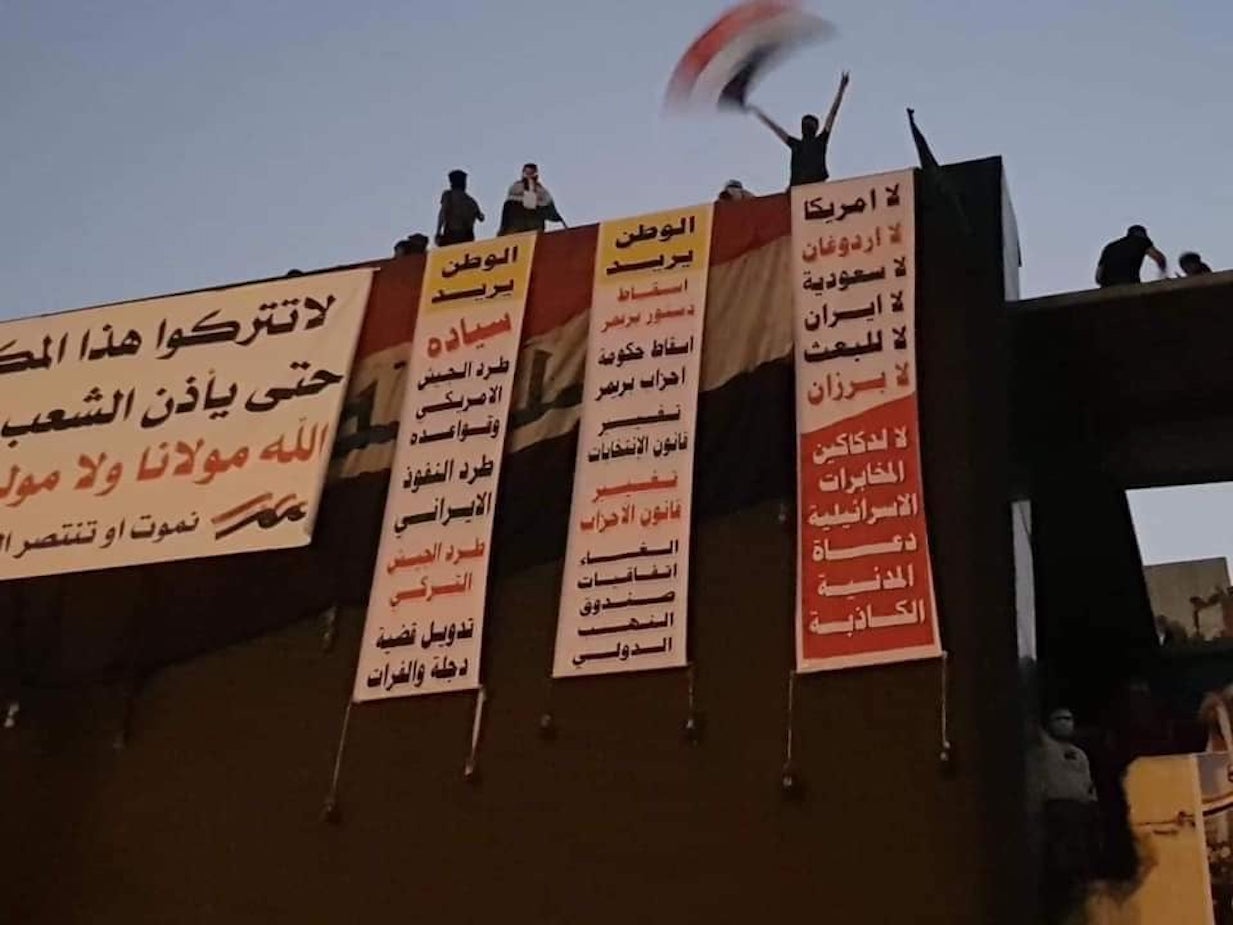
As the protest movement in Iraq launched a second wave of demonstrations across Iraq on 25th October, observers witnessed a shift in rhetoric in contrast to the first wave. During the first wave of protests, which began on 1st October, protesters were accused of being aimless, with some protesters demanding employment and other demanding the fall of the Government. Furthermore, the slogans used were largely aimed at the Iraqi Government. However, by the time the second wave was launched, protesters showed signs of organisation and the slogans started highlighting pro-unity, anti-sectarian, and anti-foreign intervention messages.
Videos were posted showing residents from the predominantly-Sunni city of Fallujah in Baghdad passing out food and expressing their solidarity with the protesters. Other expressions at solidarity included online support for protests in Sunni-majority provinces, who said that the revolution is not Sunni or Shia, but rather Iraqi. While most outlets focussed on the anti-Iran rhetoric, which culminated in the burning of the Iranian consulate in Karbala Province, protesters hung a large poster on the “Turkish Restaurant” building, stating “no to America, no to Erdogan, no to Saudi, no to Iran, no to Baath [sic], no to Barzan [sic], and no to Israeli intelligence outlets peddling fake secularism.”
These statements came amidst claims made by the Iranian Supreme Leader, Ayatollah Khamenei, who alleged that the protests in Iraq and Lebanon had been caused by “the US, the Zionist regime [Israel], some western countries, and the money of some reactionary countries”. Khamenei called on Iraqis to foil the plot and retake their country. This statement, while apparently denouncing foreign intervention, was received by Iraqis as an attempt by Iran to influence the protests in Iraq. Furthermore, aggressive exchanges by Iran and the US over the Iraq and Lebanon protests have further infuriated Iraqis who have stated that these two countries are trying to exert their power, and are hijacking the demonstrations to involve Iraq in a proxy war.
During the Friday sermon in Karbala on 1st November, Iraq’s Highest Ranking Shia cleric, Ayatollah Sistani, through his representative, condemned the use of violence against protesters and voiced his opposition to foreign intervention in the country. Clarifying the stance of the Marja’iyah on the protests, Sistani claimed that reform must be undertaken by the Iraqi people, and that “no person, group or party with certain ideology, regional or international side has the right to confiscate the will of Iraqi people or impose an opinion on them”.
To many people, this statement appeared to be responding to an earlier statement by Khamenei, while others have stated that Sistani’s indirect statement also includes the US and other foreign entities who have been seeking to intervene in the country.
Meanwhile, the current Iraqi political class, which has flourished on sectarian divisions and ethnic and religious based quotas, is scrambling to appease the protesters rejecting their rule. Parliamentary efforts to approve a bill cancelling privileges and bonuses for senior politicians, including the President, Prime Minister and Cabinet Ministers, has done little to appease protesters. In a further attempt at reconciling with protesters, Iraqi President Barham Salih announced that Prime Minister Adil Abd al-Mahdi would resign from his position if parliament could agree on his replacement. Furthermore, though there was an attempt to hold a vote of no confidence in the PM in Parliament last week, most blocs were not behind holding this vote, further enraging protesters more broadly against the political class.
As the movement grows more civic-minding nationalistic and anti-sectarian, efforts to increase coordination and consistency continue. Among others, the movement has produced a newsletter named “Tuk-Tuk”, expressing the movement’s desire for constitutional and electoral reforms, as well as other demands relating to the formation of a new government. However, despite these united positions, and organisation, the situation remains unclear, especially as reports say that the security forces are responding more violently to the protests. Whether these protests will succeed in achieving their demands or not is unclear; however, they have showed that many citizens in the country are seeking to move past the sectarian lines that have afflicted the country with conflicts for several decades, marking future movements plan and simply, as “Iraqi”.
For more information on this subject and other developments in Iraq, subscribe to our daily intelligence reports and weekly digests.