

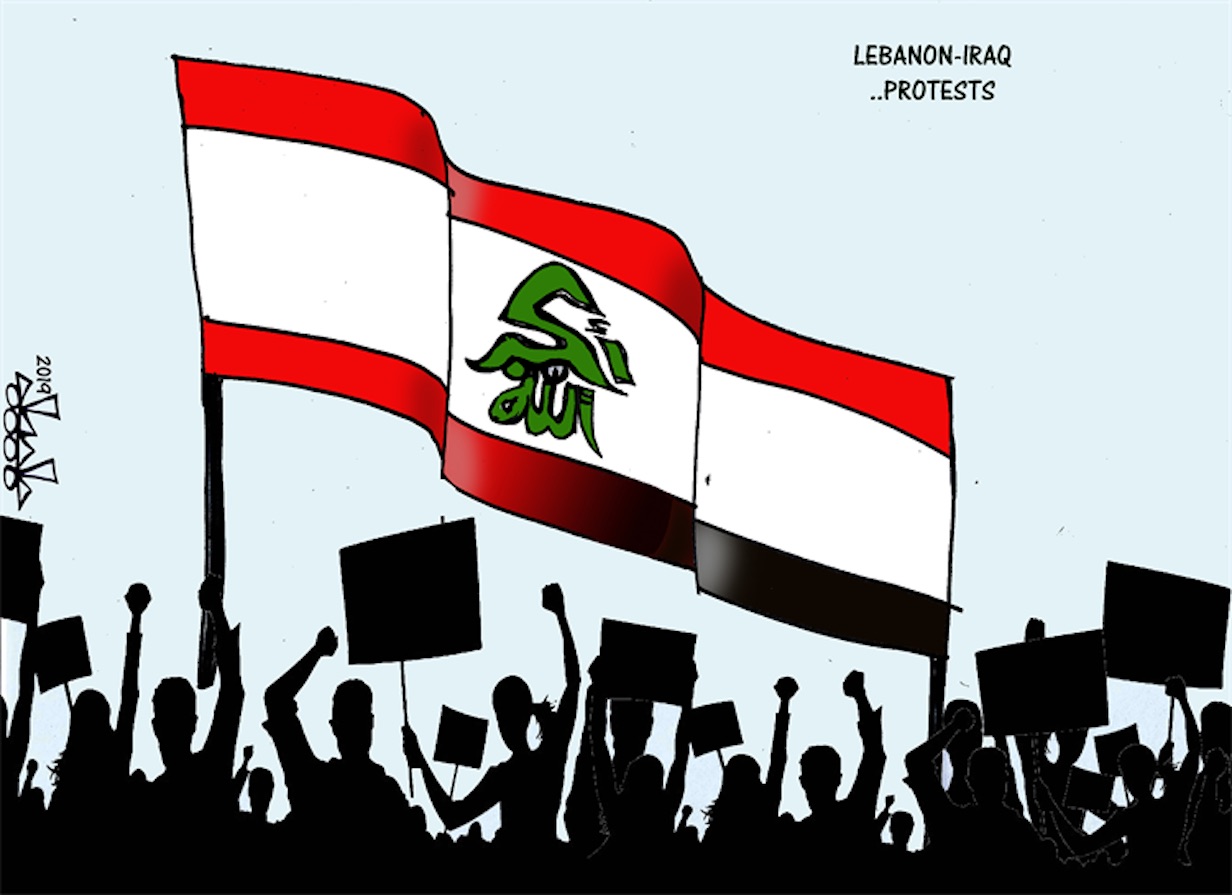
Tens of thousands of protesters remain out on the streets of Lebanon’s largest cities as concern about the state of the national economy and corruption in the country continue to grow. Whilst people initially took to the streets Thursday (17th October) to protest against a proposed daily tax of $0.20 on WhatsApp and other messaging app voice calls, the unrest has since grown into a wider protest movement against the political class encompassing wide-ranging social and economic grievances. Some protesters targeted the country’s “corrupt” ruling elite, with foreign minister Gebran Bassil being singled out for extra criticism at some rallies, having long been accused of attempting to stoke sectarian divisions in the country for political gain. However, Bassil was far from the main target of protests in Lebanon, with others chanting slogans criticising the Banque du Liban (Lebanon’s central bank) for its alleged complicity in allowing corrupt politicians to embezzle money out of Lebanon.
On Friday 18th October, the Prime Minister of Lebanon Saad Hariri announced a 72-hour deadline to agree on a set of reforms aimed at appeasing the demands of the protesters. Proposed reforms included halving the salaries of ministers, as well as guaranteeing 24-hour electricity provision. Whilst these reforms were agreed on by the cabinet on Monday 21st October, they failed to appease protesters as hoped, with tens of thousands gathering in central Beirut the following day.
Economic hardship in Lebanon has been the recent source of unrest and protest, including at the end of last month, when several hundred protesters descended on central Beirut’s Martyrs Square to express discontent at politicians and business elites siphoning off public money at the expense of the working population. In addition, it was clear to see a resistance emerging against social and economic relations being defined increasingly along sectarian lines. No image illustrated Lebanese dissatisfaction with sectarian identity politics more powerfully than the human chain that was formed by tens of thousands of protesters from all sects in Lebanon, starting from Tripoli in the north of the country to Tyre in the south, spanning 170 kilometres and passing through the main protest hub, Beirut.
The Lebanese Armed Forces (LAF), which is generally seen as a non-sectarian force that has kept civil war from re-emerging since the military entity was restructured after the Civil War of 1975-1990, has been given orders to quell protests, and videos have been circulating on social media of army forces forcibly removing demonstrators at sit-ins in central Beirut. That said, other soldiers were pictured reluctantly carrying out orders, having been overwhelmed with sympathy for the protesters’ demands. Chants of “God is with the army” are commonplace when the army is present at demonstrations, and some soldiers have told news reporters of their frustration at not being able to refuse their orders to quell protests where they threaten to cause road closure, despite sharing all of the same grievances as those who have taken to the streets. One highly respected civil society organisation, Beirut Madinati, posed the rhetorical question of who is causing the LAF to go against protesters, if the two are united in their grief.
Although protests have been distinctly non-sectarian and focused on political and economic grievance, motorcyclists have been seen carrying Hezbollah flags around Beirut. Hezbollah dismissed the suggestion that these flag-bearers were representative of their organisation, blaming “thugs” affiliated with the Shia-led Amal Movement for the incident. Meanwhile, Beirut Madinati has sought to emphasise the power of individualist thought over sectarian identities or political affiliations at the protests, stressing the need to respect a constitution outside the paradigm of sectarianism. The organisation also stressed the importance of having de-centralisation of protests in Beirut and elsewhere.
Meanwhile in Iraq, protests over high unemployment, poor public service provision and government corruption broke out on 1st October and were quickly met with a violent security crackdown as the Iraqi Security Forces (ISF) opened fire on protesters in the capital, Baghdad. Protesters in the country believe that political infighting within government has distracted the Iraqi government from its task of improving people’s lives, two years after the Islamic State (ISIS) was territorially defeated in Iraq. Prime Minister Adil Abd al-Mahdi struck a somewhat reconciliatory tone in response to the protests, vowing to help provide poor families with a basic income, to increase housing provision and to tackle corruption.
This rhetoric was comprehensively undermined by the levels of violence experienced, however, as the death toll rose to over 100 within a week, according to the Iraqi High Commission for Human Rights. Earlier this week, the Investigation Committee set up by the Prime Minister to investigate the use of violence since protest began announced through a televised statement that a total number of 149 civilians had been killed, with over 4,200 injured. This sharply contrasts with the largely restrained response of security forces in Lebanon, where two people are believed to have been killed since protests began. The following week, Iraqi President Barham Salih condemned the violence levelled against protesters and media organisations, urging the ISF to show restraint and preserve the civil rights of all Iraqis. Alongside calling for electoral reforms to meet protesters’ demands, he also said in his televised speech that compensation should be offered to those affected by the first week of violence.
Meanwhile, Iraqi Shia cleric, politician and leader of the Sadrist movement in the country, Muqtada al-Sadr, called for fresh elections to be held, urging the government to “respect the blood of Iraq through…resignation”. Sadr, who leads the largest opposition bloc in parliament, ordered his lawmakers to refrain from participating in legislature-making until the ruling government offers a programme for the benefit of all Iraqis. Although Sadr has yet to formally endorse the protests, one senior politician in his party, Awad Awadi, referred to the protests as “a revolution of hunger”. Beginning on Friday 25th October, a fresh wave of violence rocked the country as 67 were believed to have been killed and over 2,000 over the course of Friday and the weekend, with Abd al-Mahdi ordering members of the country’s elite Counter-Terrorism Service (CTS) onto the streets of Baghdad and Nasiriyah to “use all necessary measures” to end the protests.
The protests in both Lebanon in Iraq have noticeably crossed sectarian lines and seen the participation of all sectors of society. In Lebanon, Hezbollah’s unprecedented stance of siding with the authorities against protesters indicates that it feels less able to count on Lebanese Shias for the backbone of its support than before, emphasising the wider range of social, economic and political grievances that have driven people out onto the streets. In Iraq, meanwhile, it is particularly significant that Iraq’s top Shia cleric Grand Ayatollah Ali al-Sistani joined the condemnation of what he termed “undisciplined elements” who opened fire on demonstrators, seemingly referencing alleged Iran-backed militias, a move which could help to keep future sectarianisation of the protests at bay. In two counties all too often defined by their divisions, these mobilisations, refreshingly blind to the backgrounds of fellow participators, point towards a greater recognition of the pressing need to address structural economic issues in the region, as opposed to allowing one set of interests to triumph over another, to create a society that serves all of its citizens.
For more information on this subject and other developments in Iraq, subscribe to our daily intelligence reports and weekly digests.
Image Credit: Hassan Bleibel