

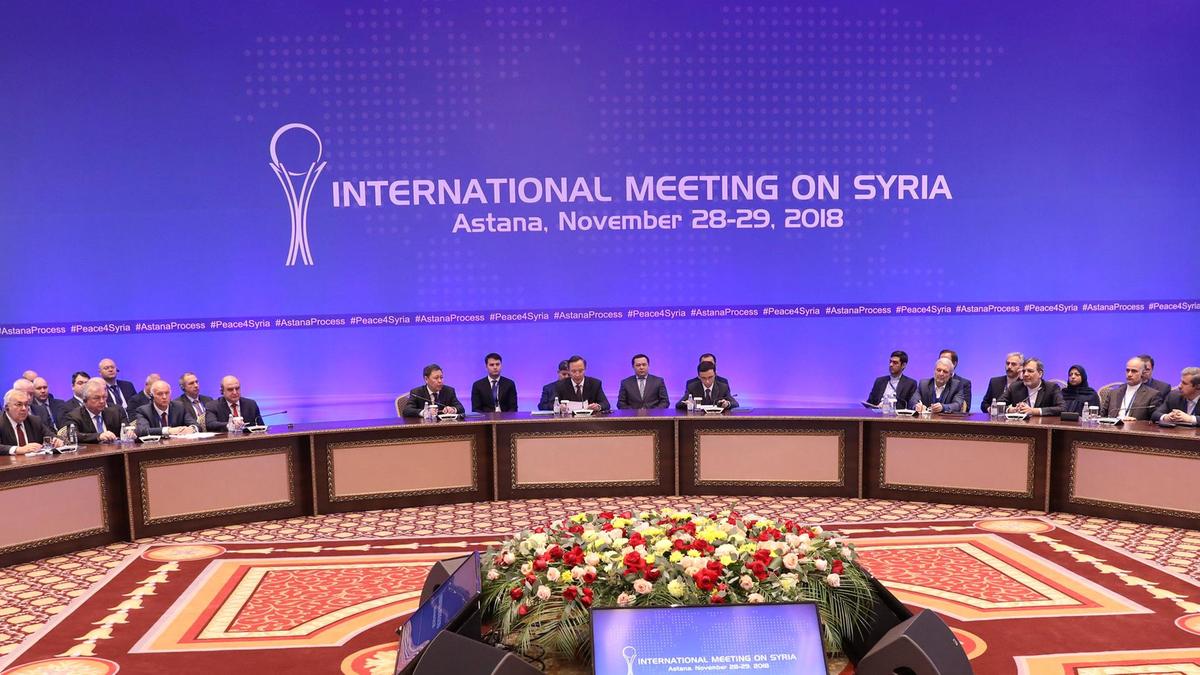
On Thursday, 29th November, representatives from Russia, Syria, Iran and Turkey met with UN Special Envoy to Syria, Staffan de Mistura, on day two of the Astana talks to discuss the recent progress surrounding the implementation of the Idlib de-militarised zone (DMZ) in northern Syria. Following the meeting, Moscow, Damascus, Tehran and Ankara issued a joint statement in which they expressed their concerns with ongoing ceasefire violations in the Idlib DMZ and would “step up their efforts to ensure observance” of the DMZ agreement, but stressed the need to continue “the fight against terrorism”. In addition, the four countries reaffirmed their commitment to the establishment of a Syrian constitutional committee, stating that they will intensify consultations to establish the committee as soon as possible.
Despite the pragmatic tone of the four countries’ joint statement, the office of de Mistura claimed that Russia, Syria, Turkey and Iran had failed to make any tangible progress in setting up an independent, Syrian-led constitutional committee at Thursday’s meeting. The statement released by de Mistura’s office added that the Astana meeting, which was the last scheduled meeting for the Syria Peace Process in 2018, has been “a missed opportunity” to accelerate the establishment of a UN-facilitation constitutional committee.
The Astana meeting was held following a week of increased tensions between rebel factions in Idlib Province, as well as assassinations and bombings. Overnight on Monday 26th, the media office of the National Liberation Front (NLF) warned that the militant coalition Hayy’at Tahrir al-Sham (HTS) was bringing in reinforcements to the vicinity of the town of Ma’arat Nu’man in what appears to be preparations to launch an attack. Whilst no clashes have yet been reported, a motorcycle bomb did explode in the town on Monday evening.
In addition to the increased tensions, towards the end of last week and the beginning of this week, the region witnessed some of the highest-profile assassinations to take place. Prime among them were the assassinations of veteran activists Raed Fares and Hammud Junayd by unknown gunmen in the town of Kafr Nabl, located 10km west of Ma’arat Numan. Fares was one of the most renowned non-violent civil society activists in Syria and responsible for the town’s iconic protest movement, which combined tragic elements of the war with biting humour. Many Opposition activists have blamed HTS for his killing due to Fares’s recent criticisms of the group. His death comes amidst further reports of the militant coalition arresting a number of civil society activists in Saraqib for protesting against the HTS-aligned Syrian Salvation Government (SSG); confiscating Christian properties in Idlib and handing them over to the SSG; and arresting members of the Idlib City Council and raiding their homes.
In response to the HTS’ continued acts of violence and human rights abuses, Idlib City witnessed significant demonstrations over the course of this week. As the HTS continues to instigate violence in the region and impede the Syrian Peace Process, support for the militant coalition will likely continue to wear thin across the region. Until now, Turkey has avoided taking military action against the HTS, instead approaching the group with pragmatism by empowering the NLF and incentivising less hard-line elements of the HTS into integrating into the wider Turkish-backed forces. However, the ever-fragile nature of the DMZ could prompt Turkey and the NLF to more actively disband the militant coalition in the coming months in order to avoid a wide-scale military incursion into the province that would likely result in a humanitarian catastrophe.
For more information on this subject and other developments in Iraq and Syria, subscribe to our daily intelligence reports and weekly digests.