

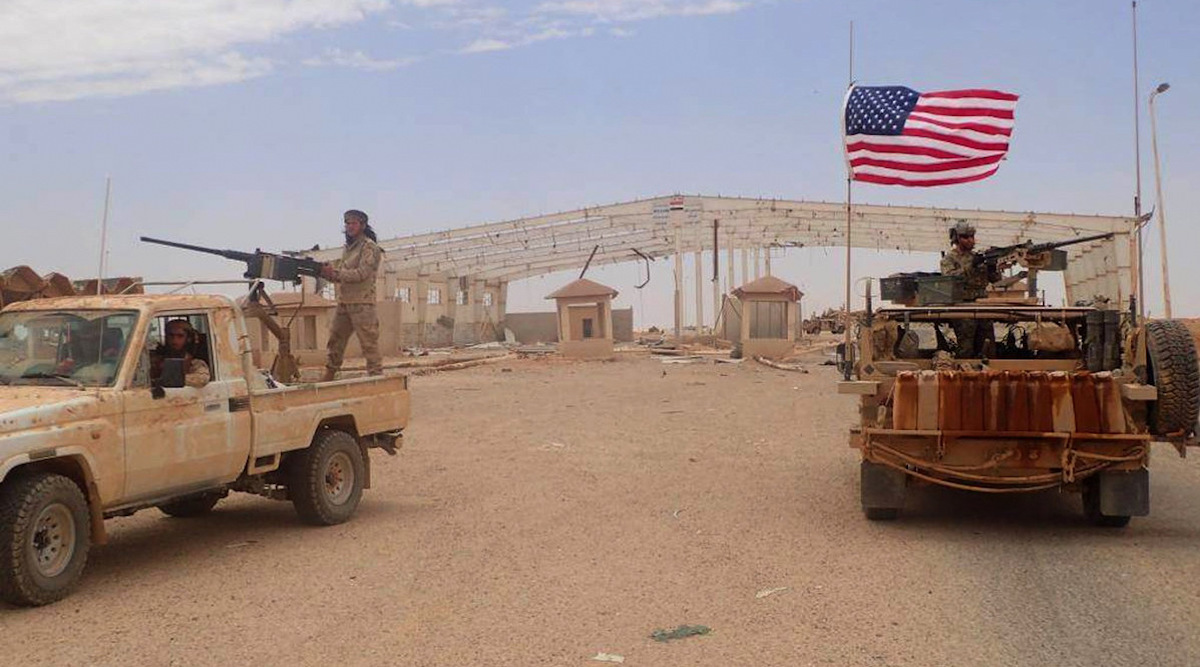
On Friday 7th December, reports emerged that Russian Chief of Staff General Valery Gerasimov had made an offer to the US-led International Coalition forces in the Tanf Base in the Syrian Desert/Badiya al-Sham to establish joint control and security over the region. According to these reports, Gerasimov said these measures would alleviate the humanitarian situation in the nearby Rukban Refugee Camp. The Russian offer, however, was not taken up by the Coalition.
Earlier this week, in response to the declined offer, the Head of Russia’s National Defence Control Centre, Colonel-General Mikhail Mizintsev, accused the US of holding the nearby Rukban Refugee Camp and the wider region “hostage”. Similar comments were made by a Russian Foreign Ministry Spokesperson, Igor Tsarikov, who accused Washington of “dubious activity” in the Tanf region and for the failure of the aid delivered to Rukban reaching those in need.
Moscow’s recent political attacks against Washington over the impasse in the Tanf region have come amid contradictory reports of clashes in the region. Over the weekend of the 8th and 9th December, International Coalition forces are reported to have shelled Syrian Arab Army (SAA) positions near the Ghurab Mountain. In addition, pro-SAA sources reported the killing of at least 23 ISIS militants during an ambush near the militant pocket in the Badiya al-Sham/Syrian Desert in eastern Homs.
Since then, however, the Hammurabi’s Justice News, a pro-Opposition outlet linked to the rebels in the Tanf Base, have claimed that the images posted by the SAA belong to the ISIS militants killed by the International Coalition near Tanf this weekend, in the same bombing that pro-Government media claimed to have targeted the SAA. The outlet accused the SAA of falsely attacking the Coalition and falsely taking credit for the deaths of ISIS militants.
Moreover, in related news, reports emerged on Tuesday 11th December that Jordan had cut off the water supply to the Rukban Refugee Camp, which is located within the International Coalition-controlled Tanf region. While no official acknowledgement has been made on the matter, a number of activists already accused Russia of pressuring Jordan to shut down the water supply in order to make continued residence in Rukban, and continued Coalition control over the area, untenable.
The increased pressure from Moscow on the International Coalition to withdraw from the Tanf region has come as Turkish President Recep Tayyip Erdoğan announced this week that the Turkish Armed Forces will launch its operation against the International Coalition-backed Syrian Democratic Forces (SDF) “within days”. Erdoğan had previously threatened to advance deeper into SDF-held territories in north-eastern Syria following its capture of the city of Afrin from the Kurdish People’s Protection Units (YPG), a major component of the SDF, in March this year.
The announcement by Turkey has further threatened the International Coalition’s role in preventing the resurgence of ISIS in the region, in addition to monitoring, and ultimately preventing, the expansion of Iranian-backed forces in southern and north-eastern Syria. Despite the recent political attacks from Moscow, it is improbable that the International Coalition will be willing to negotiate its position in the Tanf region so long as its status in the eastern Euphrates region remains threatened by Turkish advances. In addition, it is likely that the foremost concern of the International Coalition is the possibility that Iranian-backed forces, or indeed ISIS, could capitalise on the power-vacuum that would be left in the Tanf region should it decide to withdraw in the near-future.
Image: Mint Press News