

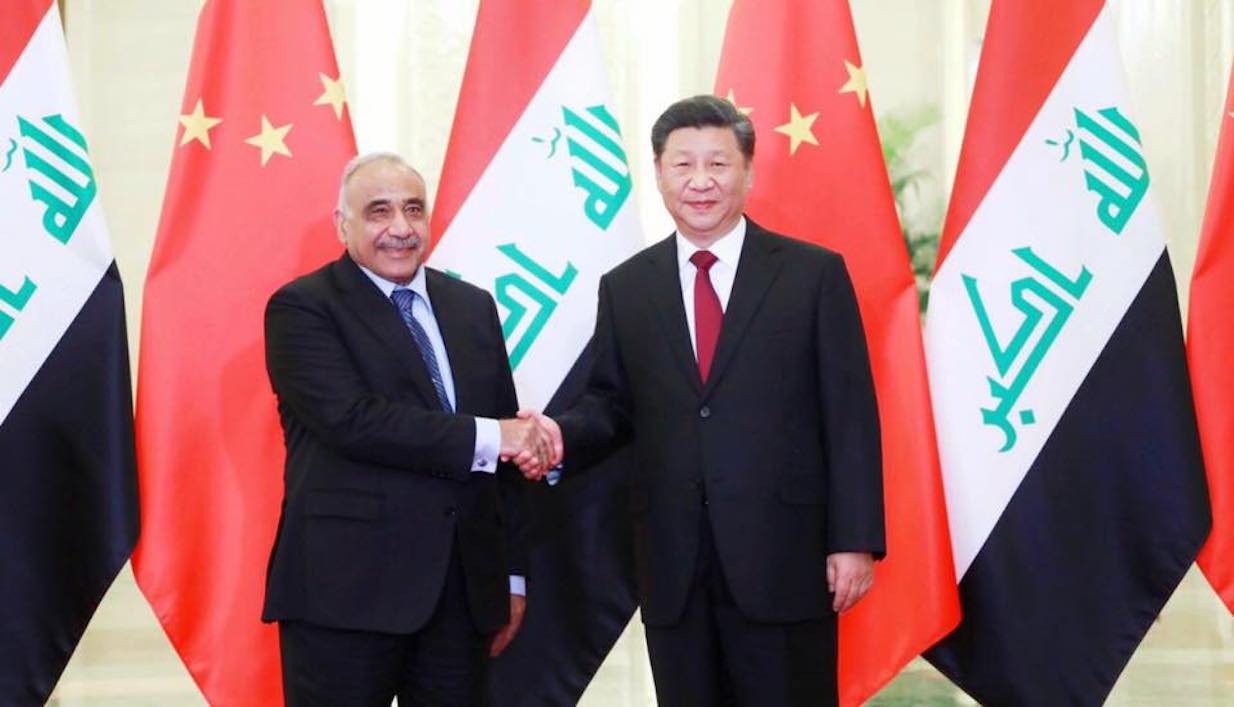
Marking one of the most significant foreign visits in Iraq’s recent history, Prime Minister, Adil Abd al-Mahdi, travelled to China on Thursday 19th September, leading a delegation of 50 people consisting of government ministers – including the Ministers of Defence and Interior – as well as numerous provincial governors.
During the visit, which lasted until the 24th of September, a remarkably long time as far as usual standards are concerned, the Prime Minister signed eight Memoranda of Understanding (MoUs) with the Chinese President, Xi Jinping, covering the sectors of security, electricity and infrastructure. Numerous provincial governors also signed MoUs relating to building transport links. Indeed, speaking at the World Manufacturing Convention, Abd al-Mahdi indicated that he would like China to have a role in rebuilding the country, with the Chinese Ministry of Trade signing an MoU with the Iraqi Ministry of Finance towards post-ISIS reconstruction. Perhaps more significantly, Abd al-Mahdi indicated to the press on Monday that Iraq would be willing to work as part of the Belt and Road Initiative, China’s cross-continent transport and infrastructure project intended to improve and extend connections between its mainland and the markets in Europe.
These developments are significant for both countries. For Iraq, it is a chance to diversify its partnerships and alliances as it seeks to frame itself as a neutral mediator and a bridge in the Middle East. Just as Iraq’s post-ISIS foreign policy has been defined by the desire to build simultaneous relations with regional powers such as Iran, Turkey and Saudi Arabia, it appears to be taking a similar approach by building relations with China to balance against its pre-existing and often-tense relations with the United States. In doing so, Abd al-Mahdi likely hopes to have greater room for political manoeuvring internationally while easing some of the pressure Baghdad faces from Washington over its relations with Tehran.
Economically, Abd al-Mahdi likely hopes that reconstruction deals with China and increased sales of oil can support his government even as he faces increasing domestic challenges within the country’s political arena. Despite many pledges for reconstruction – not only in ISIS-hit areas but across the country – actual progress has been slow, and frustration is building from Basra to Mosul. Previous Chinese projects based on the sales of oil have led to tangible reconstruction efforts in post-conflict countries such as Angola and it is likely that Abd al-Mahdi wants a similar outcome in Iraq. For China, the purchase of Iraqi oil represents a less politically-charged alternative to Iran. Furthermore, Iraq stands to benefit from the Belt and Road and improved transport links due to neighbouring Iran, Saudi Arabia and Turkey all being part of the initiative as well. Similarly, while Syria is not part of the initiative, China is already involved in reconstruction there. Iraq can therefore serve as a vital transport and logistics hub.
Deals with China, however, are not a miracle solution for Iraq and could worsen tensions if implemented wrongly. In Angola – whose export is predominantly oil like Iraq – reconstruction has been uneven and confined to the capital Luanda. Furthermore, lack of efforts to fight corruption and diversify the economy brought the reconstruction to standstill after oil prices crashed in 2014. China has also been implicated of practicing debt-trap diplomacy by offering generous loans in good times that become unsustainable when economic conditions change. Such was the case in the Hambantota Port in Sri Lanka where the government was unable to make payments for Chinese improvements to the area and was forced to lease it to China for 99 years. In many African countries with troubled economies, Chinese investments were accused of substandard quality, cheap imports pricing local producers out, environmental damage and other sources of tensions.
Effective, equitable and sustainable reconstruction is the key towards Iraq’s reconstruction and Iraqi officials should not be afraid to drive a hard bargain to ensure the best outcomes for Iraqis. The case of Mozambique shows that when Chinese investors are held into account, they are willing to abide by local demands and needs.
While this venture into the east Asian market is one that may develop infrastructure and reduce pressure on Adil Abd al-Mahdi’s Government, Iraq must also provide assurances to the US in order to balance its political equations. Some MPs have already stated that the US is pressuring Baghdad not to follow through with all of the deals with China. As a result, Baghdad, while successfully striking these deals, must be cautious of US pushback, while also continuing to seek infrastructure development. This may be the direction that Iraq is seeking to take, especially following announcements that the Prime Minister will be visiting the US soon.
Furthermore, where necessary, Baghdad should not be afraid of exploring alternative infrastructure developers. Japan, for instance, has a similar development model as China and is known for the quality of its projects even if the scale of its projects are not as ambitious as China’s. Japan is already viewed positively by many Iraqis – mostly on account of the enduring popularity of the former Japanese ambassador to Iraq, Fumio Iwai – and has had experience in infrastructure development projects in the country. Furthermore, Japan’s relations with the US are friendly, which may ease the political pressures on Iraq.
For more information on this subject and other developments in Iraq, subscribe to our daily intelligence reports and weekly digests.