

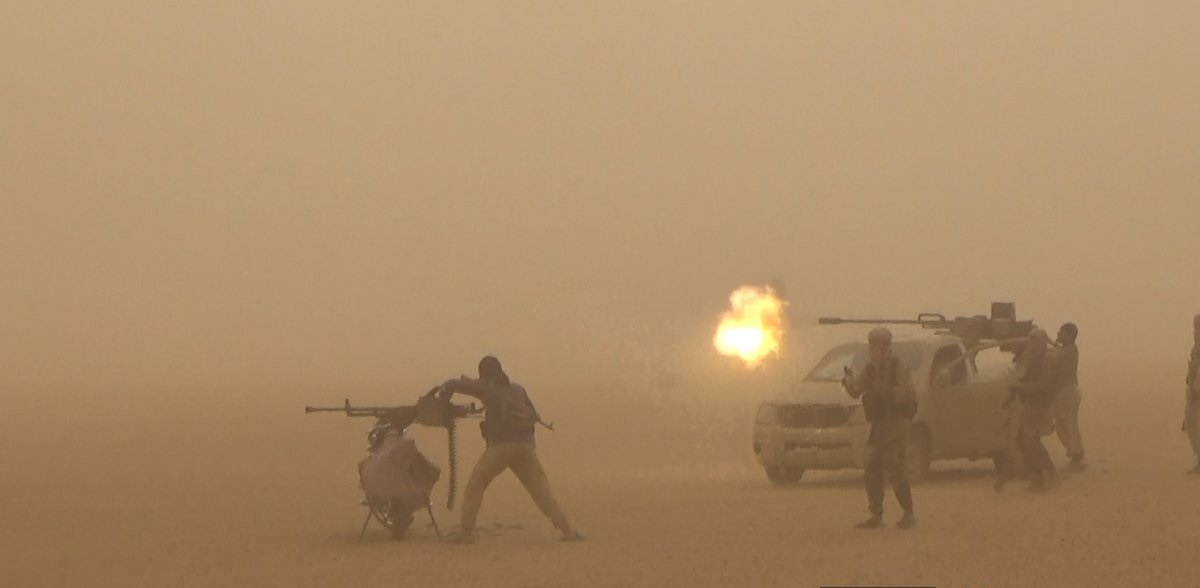
Over the weekend of the 27th and 28th October, reports emerged of the Syrian Democratic Forces (SDF) suffering a complete rout in the areas surrounding the ISIS-controlled southern Euphrates Valley, Deir ez-Zour Province. Following a number of attacks carried out against the SDF last week, ISIS took advantage of the sandstorms on Saturday 27th to escalate its attacks and advance on the SDF positions surrounding the town of Sousah.
The gains of ISIS were facilitated to a great extent by the failure of the two SDF-affiliated factions present in the area, the Deir ez-Zour Military Council (DMC) and the People’s Protection Units (YPG), to communicate with each other and coordinate its counter-attacks. Accordingly, the SDF failed to clear and secure a number of tunnels used by the militant group, allowing the militants to encircle the SDF with a number of inghimasi (suicide) attacks behind the lines. As a result of the inghimasi attacks, YPG fighters were forced to withdraw from their positions. The lack of coordination with the DMC meant that despite leading the counter-attack against ISIS, the DMC were ultimately left stranded by the retreat of the YPG.
The DMC are reported to have suffered the heaviest losses of the battle against ISIS. Pro-SDF sources reported that the retreating DMC fighters were scattered and targeted by ISIS. This, in turn, prompted a full retreat, allowing ISIS to recapture the villages of Baghuz Fawqani, Baghuz Tahtani and Mozan, as well as the Baghuz Mountain. By all accounts, the retreat was disorderly, with many armoured vehicles left behind, forcing the International Coalition to conduct airstrikes on the vehicles before they could be used by ISIS. However, ISIS-linked social media have since posted images of American-made armoured vehicles including Humvees under militant control, suggesting that the Coalition airstrikes failed to destroy all vehicles left behind.
With the SDF control over the Iraqi Border disrupted, ISIS attempted an attack into Iraq itself but was repelled by the Popular Mobilisation Units (PMU) on the other side. Qasim Musleh, the PMU’s Anbar Commander, stated that the SDF and the International Coalition retreated from the border and that the PMU was mobilising to seal the border on the Iraqi side. Since then, the PMU has been shelling from the Iraqi side of the border, effectively creating a no man’s land around Baghuz Tahtani to prevent militants getting through.
Despite an earlier announcement of further reinforcements of SDF factions, the YPG announced on Tuesday 30th that it would suspend its operations in the region on account of the Turkish Armed Forces (TSK) shelling in northern Syria. Moreover, between Monday 29th and Tuesday 30th, the SDF was forced to withdraw further from the vicinity of the Baghuz Mountain, as well as the South Kishma Oil Field and many positions along the Iraqi Border.
Even though the SDF has inflicted numerous battlefield defeats against ISIS over the previous two years, which has included seizing control of ISIS’ former capital city of Raqqa, it has comparatively struggled to clear the southern Euphrates Pocket on the Iraqi border. Many of the militants present in the region are experienced fighters, having previously fought in battles against the SDF or the Syrian Arab Army (SAA). The weekend’s fighting has confirmed that for the SDF to defeat the last remaining ISIS pocket within its territory, communication and coordination between each respective SDF faction will need to drastically improve.