

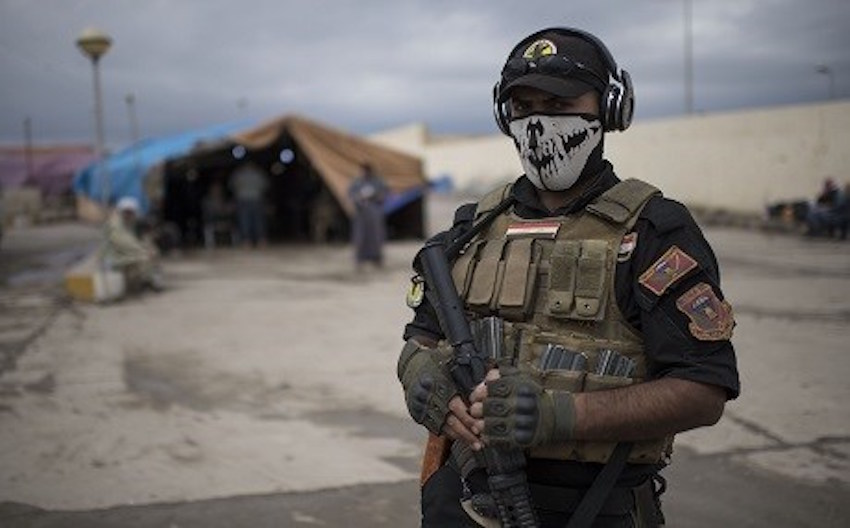
Last week, the Iraqi Security Forces (ISF) launched its latest counter-terrorism operation, named Operation Will of Victory, to root out ISIS insurgents operating in the provinces of Nineveh, Anbar and Salahuddin in the northern and western parts of Iraq. An additional operation in Diyala Province, which is being carried out simultaneously, is aimed at eliminating ISIS hideouts in the Hamrin Mountains, whilst also sealing off an escape route for insurgents fleeing from Operation Will of Victory.
Moreover, an additional campaign in northeastern Syria by the Syrian Democratic Forces (SDF) and the Syrian Arab Army (SAA) – named Operation Jazeera Storm – has already led to the sealing of the Syrian side of the border. This has enabled the ISF to begin the second phase to the operation to neutralise and dismantle the ISIS insurgency.
According to the United States Defence Department, an estimated 14,000 to 30,000 ISIS militants have remained active in Iraq since its loss of territory in the country in late 2017. Since then, ISIS insurgents embedded in the countryside have launched attacks across northwestern Iraq, including more recently destroying more than 134,000 acres of agricultural land through its scorched earth policy to disrupt Iraq’s food supplies and rural economic growth.
Nevertheless, in a statement issued at the beginning of the week, the Iraqi Joint Operations Command has said that ISIS’ capabilities across Anbar, Salahuddin and Nineveh Provinces have been destroyed as a result of the first phase to the operation. Indeed, over the past week, more than 50 ISIS hideouts and training camps have been captured by the ISF, in addition to the seizure of weapons, ammunition and explosives.
The completion of the first phase of Operation Will of Victory will likely serve as a morale boost for rural communities in Iraq, which have regularly been extorted for money by ISIS militants under the continued threat of further attacks or crop fires. Moreover, the success of phase one is symbolic of the military advantage that the ISF has gained over ISIS since the militant group returned to its insurgency roots.
Despite the large presence that ISIS had maintained in Iraq, its membership and capabilities to conduct attacks across Iraq have rapidly declined since the loss of its territorial hold at the end of 2017. Indeed, the number of terrorism-related deaths in Iraq fell more than 50% in 2018 compared with 2017 as a result of ongoing security operations. Accordingly, if the subsequent phases of Operation Will of Victory are successful, it could result in a notable reduction in ISIS activity in Iraq and prevent its further expansion into liberated communities.
Nevertheless, the launch of Operation Will of Victory one-and-a-half years after the defeat of ISIS as a territorial group proves that the fight against ISIS is a long-term battle that cannot be won through military means alone. Indeed, the latest campaign against ISIS does little to address the militant group’s ideology, which at its height in 2015 and 2016 attained a global appeal and prompted fighters from numerous countries to travel to Iraq and Syria, as well as to carry out individualist attacks in their home countries.
To tackle this, the Iraqi Government, together with religious institutions and Iraqi civil society groups, will need to work together to root out the group’s ideology that continues to fester amongst communities in northwestern Iraq and provide a viable alternative to violence for disenfranchised Iraqis through increased services and economic support. Without this, Operation Will of Victory will succeed militarily, but will fail to eliminate ISIS in the long-term.
Image: Christophe Simon/AFP