

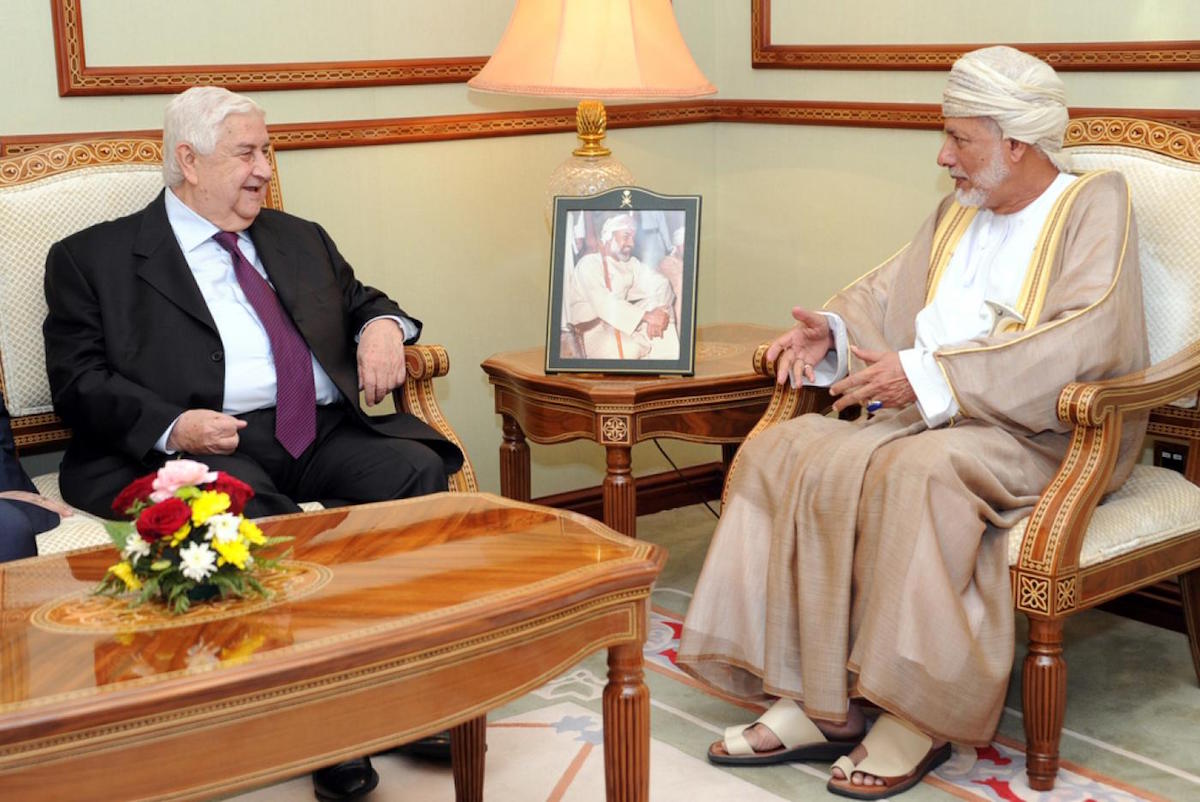
Last Sunday, 7th July, Syrian President Bashar al-Assad and the Syrian Foreign Minister, Walid al-Moallem, met with the Omani Foreign Minister, Yusuf bin Alawi. During the discussions, which took place in Damascus, the two sides discussed bilateral relations and regional developments and security. Bin Alawi’s visit is the second such visit to Damascus by an Omani Government representative since the Syrian conflict broke out eight years ago. Muscat has traditionally adopted a neutral role in the region as the only country to maintain ties with Iran, Saudi Arabia and Israel simultaneously. Accordingly, it is possible that bin Alawi’s visit was intended to restart the stalled rapprochement between Damascus and other Gulf states, particularly Saudi Arabia and the United Arab Emirates.
Last December, the UAE, along with Bahrain, became the first of the Gulf states to reopen their embassies in Damascus almost eight years after they were closed in response to the escalating conflict. Following the reopening of the UAE embassy, the Emirati Foreign Minister, Anwar Gargash, stated that the UAE’s decision to reopen its embassy “came after the conviction that the next stage [of Syria’s reconstruction] requires Arab presence and communication”. Gargash added that this was in response to the deepening influence of Turkey and Iran in the country.
It is unlikely, however, that the two countries will be able to counter the influence of Iran in Syria, which has been present in the country at the invitation of the Syrian Government. Instead, it is likely that the UAE and Bahrain have reopened their embassies as part of an ongoing rapprochement between Saudi Arabia and the Syrian Government. Last weekend’s visit by bin Alawi is likely to form a part of this process, with neutral Oman taking on a role as mediator between the Gulf and Syria. This could permit Saudi Arabia to use Oman to project its soft power into Syria as the country begins to rebuild.
Nevertheless, whilst the UAE and Bahrain’s move may have Saudi overtures, the Saudi Government is not likely to act outside of the interests of the US, which rapidly denounced the reopening of the embassies last year. The US had previously stated that it does not want regional diplomatic channels to reopen with Syria until a political process to end the war, which would include a timeline for Assad’s resignation as president, has been agreed upon. As part of its support for the US, Saudi pledged $100 million last year in an effort to stabilise northeastern Syria under the control of the US-backed Syrian Democratic Forces (SDF).
However, this investment is likely to have also been pledged to disadvantage Turkey. From 2017 onwards, as the balance of power in Syria gradually shifted back towards the Government with the help of the Russian intervention, Saudi Arabia relinquished its support for the Syrian Opposition. These developments coincided with the worsening of relations between Riyadh and Ankara. Since then, Turkey has taken over as the dominant supporter of the Syrian Opposition and has since prioritised containing the perceived threat posed by the Kurdish People’s Protection Units (YPG) in northeastern Syria.
Accordingly, Saudi’s political maneuvering in Syria could place it in a position as a more reliable partner to the YPG and the SDF as the long-term strategies of the US remain unclear. Moreover, this could draw Damascus closer to Riyadh as potential partners in the ongoing negotiations between the Autonomous Administration of North and East Syria and the Syrian Government, as well as in the rehabilitation of the country. This, in turn, could draw Damascus closer to the Gulf to the detriment of Iran, which has found itself increasingly isolated on the international stage.
Image: AFP