

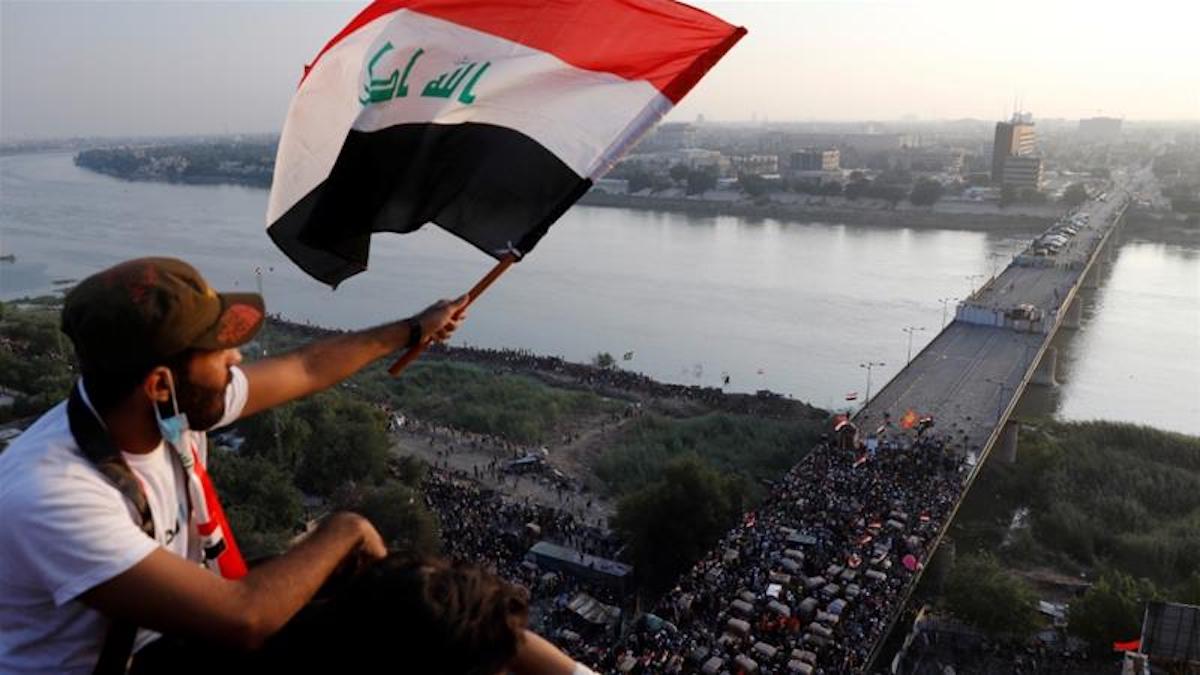
On Friday 29th November, Iraqi Prime Minister Adil Abd al-Mahdi announced that he would be submitting his resignation to Parliament. In a Facebook post, Abd al-Mahdi announced that his decision was to heed to the sermon of Ayatollah Sistani – given on the same day – which implicitly called on Parliament to hold a vote of no confidence in the PM. By Saturday 30th November, MPs stated that Abd al-Mahdi’s resignation was received in Parliament, only to be unanimously accepted by MPs on Sunday 1st December.
The resignation was celebrated by the protesters and political figures such as the head of the Sa’iroun Alliance, Muqtada al-Sadr, who called the resignation “the first victory for the Iraqi people”. Soon after Abd al-Mehdi’s resignation, officials began to scramble looking for another candidate for the post.
In accordance with the Iraqi Constitution, once the resignation is accepted, the PM and his cabinet hold “caretaker” status until his replacement is found. Furthermore, the constitution dictates that the Iraqi President has 15 days to nominate a candidate to be voted in by the Iraqi Parliament. While the process appears straightforward and swift, this has not been the case historically and there are no signs that things will be different this time.
Immediately after the resignation was accepted, political parties began scrambling to find an alternative.
While the Sa’iroun Alliance stated that it would “waiver” its right to choose a PM to the people, other parties have allegedly proposed candidates including former Minister of Oil, Ibrahim Bahr al-Uloom, former MP, Izzat al-Shahbandar, and former Human Rights Minister, Mohammed Shia’ al-Sudani. Others, including former Prime Ministers Haidar al-Abadi and Nouri al-Maliki, both announced that they would not be nominating themselves to that position.
As the debate continues regarding the successor of Abd al-Mahdi, several political parties have released a list of requirements that candidates must meet in order to be considered for the position. While for the first time in recent history, the denomination of the candidate, which had been allocated to the Shi’a denomination, was not considered, the majority of the parties stated that the upcoming PM should be accepted by the protesters and should have the blessings of the Marja’iyah.
Protesters on the other hand have stated that they do not want any of the proposed names as they are all part of the political elite that they are demonstrating against. As a sign of this rejection, protesters have been carrying picket signs, saying that “We told them the car isn’t working, so they [the politicians] decided to change the driver”. This sentiment was reflected by the majority of the protesters who said that choosing a new PM will not change the situation, demanding a complete overhaul of the political structure.
With protesters rejecting the candidates, the political elite and the new PM will face an immediate major problem. If an independent candidate is chosen, similar to Abd al-Mahdi, the PM will find it difficult to pass reforms due to a lack of party support within Parliament. Protesters say that this will bring them back to square one. If a partisan candidate is chosen, on the other hand, the new PM will face a crisis of legitimacy given that the majority of the parties are no longer viewed as legitimate by the new young Iraqi generation.
Among the compromise candidates touted by the Iraqi street are former Counter-Terrorism Services (CTS) commander, Abdul Wahhab al-Sa’edi, who enjoys popular support among many Iraqis, especially for his strong and non-partisan background. However, according to observers this nomination also brings many problems. Due to al-Sa’edi’s lack of political record and his military background, many fear that Iraq will follow in the footsteps of Egypt by choosing a military commander to lead the country.
Despite the President having ten days remaining to name his candidate, the lack of support for any of the current faces means that whoever is chosen will likely face the same pushback as Abd al-Mahdi. While it is yet too early to say whether or not the President will find a candidate, the decisions made over the next 10 days will have a strong impact on either quelling or aggravating the current crisis.
With lawmakers still making amendments to the electoral law and the electoral commission law, the passing of these laws may be the answer to Iraq’s problems. If these two laws are accepted by the people and passed soon, Parliament must vote to dissolve itself, leading the Iraqi President to call for a snap election, which will allow Iraqis to vote for new faces within the political framework. Allowing the Iraqi people to vote for new MPs to represent them in Parliament will possibly begin to mend the trust of the people in the political system; doing so will help Iraq move past this crisis.
With Iraq currently at a crossroads, the next few weeks will determine and define the pathway that Iraq will be taking in both the short and medium term. As the clock continues to tick, the current political class must make the just and moral choice in pushing the country in a direction that allows Iraq’s young generation to reach their full potential.
For more information on this subject and other developments in Iraq, subscribe to our daily intelligence reports and weekly digests.