

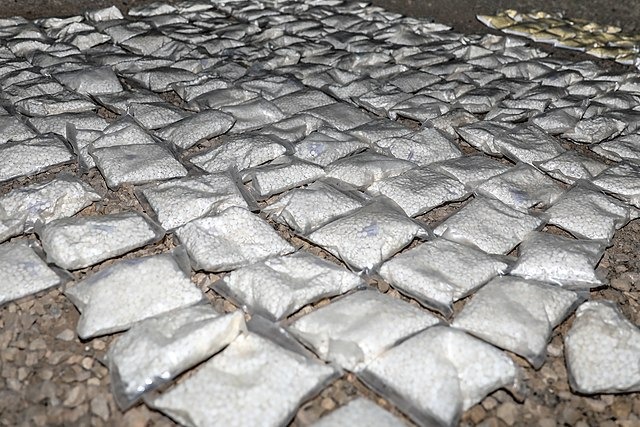
On January 27th, 2022, the Jordanian Army announced that guards had engaged with a group of smugglers attempting to infiltrate across the Jordan-Syria border, resulting in the deaths of 27 smugglers. In the aftermath of the clashes, the army announced that it has confiscated large quantities of narcotics.
Drug smuggling attempts along the Jordanian border with Syria have picked up significantly since the Syrian Arab Army (SAA) took full control of the southern provinces of Daraa and Quneitra in 2018. In addition to narcotics such as hashish, smugglers operating in Syria are best known for smuggling the amphetamine stimulant, Captagon. In recent months, authorities across the Middle East, Gulf and Europe have expressed concerns about the growing Captagon trade originating in Syria.
The conflict in Syria is no stranger to Captagon. Since the conflict erupted, Captagon production and trade in Syria has skyrocketed, with the pills bearing the iconic ‘C’ logo finding their way into every armed faction in the country, including the Islamic State (IS). However, the rapid rise in the production and trade of Captagon and similar substances have raised fears that Syria, beset with a shattered economy and sanctions, is rapidly becoming a “narco-state”.
The deeply-damaged state of the Syrian economy beset by sanctions and lack of comprehensive reconstruction is likely fuelling both the drug trade as well as drug use itself. Should these conditions not be addressed, Syria may face long-term social and public health crises relating to drug abuse, exacerbating the existing crises the country already faces due to a decade of war. Beyond that, organised crime, especially built on drugs, will make the re-emergence of conflict likelier as different factions squabble over production facilities and smuggling routes.
Rising Drugs Trade in Syria Fuelled by Conflict
Production and trade of illicit drugs in Syria and other countries in the Levant, such as Lebanon, have a long but relatively local history. In Lebanon, the cultivation of hashish, especially in the Beka’a Valley, grew in the 1960s and 1970s. The inventory of available drugs expanded to include opium poppies and cannabis, which became popular amidst the ‘warlordisation’ of the country. It is estimated that during the Lebanese Civil War (1975-1990), drugs generated around $500 million annually for the local economy. The emergence of complex amphetamines such as Captagon, however, occurred in the more industrialised Syria, in the region between Homs and Latakia, where the availability of industrial chemicals and the facilities to process them enabled production. Although such drugs occasionally found their way to insurgents in Iraq during the 2000s, knowledge of the drugs, especially Captagon, remained relatively unknown until the Syrian conflict.
When the Syrian conflict broke out and the Syrian state withdrew from increasingly fragile areas amidst growing lawlessness, armed factions were able to capture factories with the capacity for drugs production and transform them for their own use.
As early as 2013, experts were warning that production in Syria was outpacing that in Lebanon. A combination of diminished civilian economic capacity and a need on the part of fighters to remain active during combat generated demand. At the time, pro-Government militias linked to Iran were largely implicated. However, there were signs that drugs were spreading to practically every faction, including jihadi factions that normally disavow drugs.
By 2015, the knowledge that Islamic State (IS) militants consumed Captagon and other substances was becoming commonly recognised. Captagon, in particular, was noted to make the militants feel “invincible” and offered an explanation for the rapid gains made by the militants during the earlier stages of the conflict in Iraq and Syria. Similarly, the irrational levels of violence displayed by the militants were attributed by the survivors of IS atrocities to the drugs they consumed. Anecdotal examples offered to the author by those who fought against IS cells in Iraq also referenced the prevalence of Captagon and other drugs in militant hideouts.
The current state of affairs, however, is linked to more recent developments. Over the latter half of the 2010s, the Syrian Government gradually regained control over the country’s borders with Jordan, Lebanon and Iraq. The hope was that the resumption of trade and economic activity could help restore Syria’s embattled economy. However, factions that support the Syrian Government are believed to have taken advantage of Damascus’s expanded control over these border areas. Hezbollah in Lebanon, in particular, was often accused of facilitating drug production and trade alongside other, lesser-known factions backed by Iran. Amidst sanctions and destitution, the trade in drugs offered such groups a source of income, facilitating recruitment and patronage networks.
Syrian authorities have consistently denied that their country is facilitating the production and trade of drugs. Syrian state media frequently makes a show of drug busts in the areas under its control. Assuming such statements are truthful, however, belies the fact that much of Damascus’s control over the country, especially in the south, is facilitated by a smattering of armed non-state actors, local militias, loyalist warlords and other entities who have integrated themselves into state structures to facilitate their own business. It begs the question of whether Damascus could clamp down on such activities. Indeed, the emergence of the drugs trade in Myanmar’s rebellion-hit areas since 2021 shows that the phenomenon is directly linked to state weakness.
Meanwhile, the fact remains that the trade of drugs from Syria is picking up exponentially. In July 2020, Italy announced the largest seizure of Captagon from Syria, estimated at a street value of $1 billion. Similar busts were reported in Lebanon, Saudi Arabia and Greece.
The Impacts Are Far and Wide
While drugs may have poured gasoline onto the Syrian conflict, its transition to a frozen conflict is not going to put an end to the trade and production of illicit substances. Instead, the many challenges the country faces risk being exacerbated by an increasingly-entrenched drugs industry.
The most obvious and immediate factor is public health, especially with regards to mental health. Years of conflict have already taken a toll on the mental well-being of many Syrians. In a country whose healthcare system practically collapsed during the war and where psychological support was never particularly prevalent, the drugs offer a way to self-medicate the effects of PTSD and other ailments. However, such self-treatment can come with long-term psychological impacts. If the reports about the violence linked to Captagon use is correct, the impacts may be felt across whole swathes of Syrian society. Even absent such impacts, addiction will put further strain on medical services and, without rehabilitation services, can lead to increased criminality.
Indeed, criminality and conflict related to drugs is almost certainly the greatest destabilising factor Syria faces from continued drug trade. In addition to potentially turning users to crime, the drugs trade, especially those facilitated by warlords and militias, risks creating additional conflict. In the phenomenon referred to as “war for drugs”, rival criminal organisations vying for access to trade routes could engage in battles against one-another, resulting in the perpetuation of instability and incentives for continued fighting.
Having regained control over its territories on the backs of such militias, the Syrian state will likely find it difficult to clamp down on their activities even if it is pressured or incentivised to take action. In an extreme scenario, the Syrian state could end up with an open-ended drugs war in an increasingly-cartelised country.
Such effects would be deleterious on their own. However, in a geopolitical quagmire such as Syria, drugs activities will almost certainly have wider impacts. Endemic instability and recurring criminality along the Syria-Jordan border have already caused repeated border closures, hampering efforts to facilitate legitimate trade between the two countries. The matter was important enough to be brought before the two countries’ respective defence ministries and it forced direct meetings between Damascus and Amman. Jordanian officials have also become increasingly vocal about the impacts drugs from Syria are having on Jordan. Last week’s clashes along the border will almost certainly force Jordan to take firmer measures, impacting diplomatic relations between the two countries and side-tracking the Gulf efforts to bring Syria “back into the Arab fold”.
Such a rift already occurred between Lebanon and the Gulf after large quantities of Captagon hidden in agricultural produce was confiscated in Jeddah, prompting Saudi officials to impose a total ban on fruit and vegetable imports from the country at a time when Lebanon’s economy was spiralling. A similar scenario is highly likely in Syria despite the Gulf efforts to normalise relations with Damascus. For Damascus, which staked its credibility on its ability to bring order and stability to the areas it controls, the continued growth of the Syrian drugs trade represents a severe risk to its international objectives.
Ultimately, any efforts to clamp down on the drug trade will be an uphill battle and likely a violent process. Due to spiralling economies in Syria and Lebanon, there are now many factors to both pull and push individuals to drugs production, trade and use. Geopolitical factors that limit economic reconstruction such as sanctions, the impasse between Syrian factions that hampers cooperation, and the involvement of mutually-hostile foreign powers in the country will all complicate the actions taken against the drug production and trade.
There are measures that can help combat the effects of the drugs trade on Syrian society. Such measures include an effective and transparent law enforcement process, mental health support and rehabilitation for users, and the facilitation of reconstruction and gainful economic activity to reduce push factors. However, all of these measures are few and far between in Syria.