

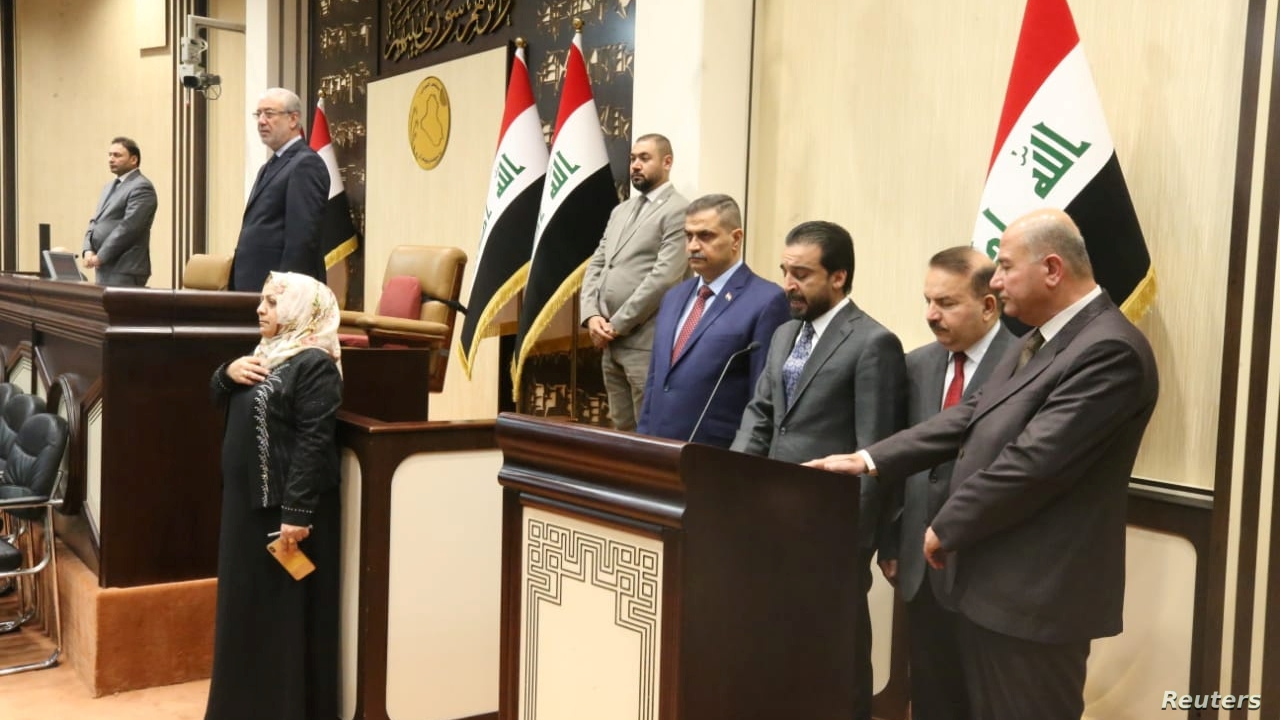
On Monday, 24th June, the Iraqi Parliament voted in new interior, defence and justice ministers, bringing an end to months of political wrangling and deadlock amongst Iraq’s major political blocs, which left key government ministries in limbo. Shortly before Monday’s vote, Iraqi Prime Minister Adil Abd al-Mahdi sent a letter to the Speaker of Parliament, Mohammed al-Halbousi, in which he rebuked parliament and political parties for delaying the formation of the government and suggested his own candidates for the key positions.
In the letter, he announced the following candidates for the remaining cabinet positions: Najah al-Shammari for Minister of Defence, Yassin Taher al-Yasiri for Minister of Interior, Farouq Amin for Minister of Justice and Safaneh al-Hamdani for Minister of Education. During the session held on Monday, the Iraqi parliament approved the candidates for the Ministries of Justice, Interior and Defence, but rejected Hamdani’s candidacy. Despite popular support for the nomination of al-Shammari, al-Yasiri and Amin amongst the political blocs in parliament, there was disagreement over the suitability of al-Hamdani. Accordingly, the education portfolio remains the only position yet to be filled in Abd al-Mahdi’s cabinet.
The vote has come following weeks of growing discontent towards the government of Abd al-Mahdi, with major political factions turning on an increasingly unpopular government that has been criticised for its inability to improve services and make a purposeful stand against corruption. Last Friday, 21st June, the Representative of Ayatollah Sayed Ali al-Sistani, Sayed Ahmed al-Safi, used his Friday sermon to express the Marja’iyah’s (Supreme Shi’a Religious Authority) disappointment over the divisions between politicians and the various political factions in Iraq that have crippled the government and obfuscated progress in key areas of governance, including reconstruction following the defeat of ISIS in 2017, delivering essential services and tackling rampant corruption.
Safi’s indictment of the government’s progress follows an earlier statement released by Muqtada al-Sadr, leader of the Sa’iroun Alliance, in which he warned the Iraqi Parliament that it had just ten days to fill the remaining cabinet posts and threatened to organise further “million man” protests against the government. Sadr also criticised the government’s failure to provide adequate electricity supplies and called for mass protests to be organised last Friday in response. Moreover, Sadr called for the electricity supply to Baghdad’s secure Green Zone to be cut so that officials “can feel the plight of the people”. Sadr’s criticism has come amidst rising discontent over continued electricity shortages in southern Iraq. The government’s growing unpopularity has prompted other parties, including the Hikma Movement, led by Ammar al-Hakim, to turn on Abd al-Mahdi’s administration. The party issued a statement on 16th June, saying that it will become part of the ‘opposition’ in parliament
Regardless, the recent developments no doubt give a significant boost to Abd al-Mahdi’s credibility, which in turn could empower his government to tackle Iraq’s security and energy crises and restore confidence amongst the Iraqi population. Accordingly, the coming months will likely present the greatest test for Abd al-Mahdi and his bolstered cabinet, especially over the summer where protesters have traditionally taken to the streets in recent years. Its competency will likely be judged by its ability to address concerns such as the energy crisis, corruption and the resurgence of ISIS attacks, whilst simultaneously guiding the country through its key reconstruction phase. Failure to do so could undermine the stability of Iraq and its post-ISIS recovery.
For more information on this subject and other developments in Iraq, subscribe to our daily intelligence reports and weekly digests.