

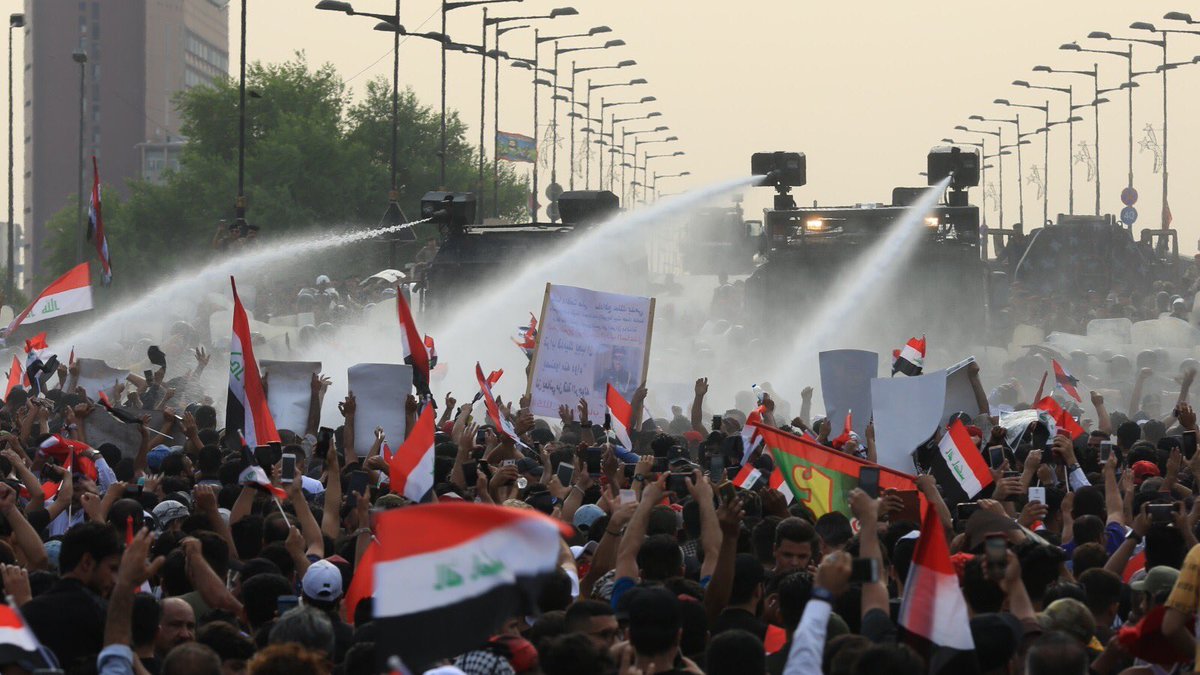
On 1st October 2019, protests broke out in Iraq, with demonstrators demanding an improvement to services and an end to corruption. Although the protests broke out in ten different provinces, the most intense demonstrations took place in Baghdad, Dhi Qhar, and Basra.
Day One – Tuesday 1st October
Planned demonstrations took place in Baghdad, Basra, Maysan, Dhi Qar, Wasit, Babil and several other provinces demanding an improvement to services, increased efforts against corruption, and, in some cases, for the fall of the Iraqi Government.
While the protests were peaceful at first, the situation quickly escalated when Anti-Riot Forces began using tear gas, water cannons and live bullets against the protesters in Baghdad, who attempted to march into the Green Zone, where the Government’s headquarters are located.
Several civilians were killed and injured in addition to material damage incurred to stores and restaurants; however, exact numbers are unconfirmed.
Protests in other provinces, aside from Basra, Wasit and Dhi Qar, were not met by as strong a push back, although the situation remained generally volatile as of Tuesday evening.
Day Two – Wednesday 2nd October
The violent response by the Anti-Riot Forces on Day 1 galvanised the protests, which spread across nine provinces, growing increasingly violent, with footage showing several protesters throwing Molotov cocktails at security forces and masked men shooting protesters with live ammunition.
According to initial reports, three people were killed and hundreds of civilians and security officers were injured across the country. Officials in the country, including Iraqi President, Barham Salih, and Prime Minister, Adil Abd al-Mahdi, called for the de-escalation of the situation.
The United States’ Embassy and the United Nations expressed concern, calling for the violence to subside and for the protection of civilians.
Opposition MPs within Parliament aligned themselves with the protesters saying that the Government must respond to their demands, while also releasing six primary demands, including providing jobs and countering corruption.
Several political parties and blocs started speculating about the protests, with some saying that they were organised by outsiders, and others accusing “instigators” of hijacking the protests and turning them violent.
By midday Wednesday, reports stated that the Government had shut down several social media websites and blocked Whatsapp and Facebook image and video sharing features in an attempt to reduce the number of videos being shared. Iraqi protestors and citizens used VPN services to circumvent this.
The PM called for an urgent meeting with the members of the National Security Council (NSC) to discuss the current situation.
Day Three – Thursday 3rd October
Protesters in Najaf, Dhi Qhar, and Maysan provinces set fire to several Government buildings and political party offices, namely the Dawa Party, Hikma Party, and Asa’ib Ahl al-Haqq.
These actions were met with strong pushback by the Iraqi Government, which enforced a curfew on citizens in Baghdad, Babil, Najaf, Maysan and Dhi Qhar provinces. According to the Iraqi Human Rights Commission, at least 19 have been killed, and an estimated 1041 people injured since the protests began.
Iraqi Speaker of Parliament, Mohammed al-Halbousi, called on representatives from the demonstrators to attend Saturday’s Parliamentary session to voice their concerns and demands. Protestors widely rejected being represented by those invited to attend.
The President, Prime Minister and Speaker of Parliament convened for crisis meetings in hope of finding a solution to the ongoing protests.
By midday, the Iraqi Prime Minister visited the Baghdad Operations Command along with the Ministers of Interior and Defence, to observe the situation in the capital.
By the evening, the Prime Minister’s Media Office published several hotline numbers, that the “representatives” of the demonstrators could use to call the Prime Minister in order to address their demands.
Several bombs were heard overnight in Baghdad’s Green Zone. Following this, the International Coalition released a statement stating their facilities were not struck; although it asserted that it reserves the right to defend itself in case of attack. The statement also called on all sides to reduce tensions and reject violence during the demonstrations. This was followed by a statement by the United Kingdom calling upon restraint form all sides.
The Turkish Ministry of Foreign Affairs also issued a statement advising its citizens not to visit Iraq due to ongoing protests.
The Iranian Ministry of Foreign Affairs released a statement, saying that “it is confident that the Iraqi Government will de-escalate the situation with the relevant parties and religious authorities”. Despite this, it advised its citizens going to Iraq for the annual Arbaeen Pilgrimage to delay their travel until the situation has settled Iran also closed two crossing points, Khosravi and Chazaba before reopening the latter.
Rumours stated that the United States called on all of its non-essential embassy workers to leave the country. The US Embassy in Iraq responded to these claims saying that it is false and that all of the staff have remained in the country. Due to the curfew imposed, the US embassy stopped all service provision.
Two activists, a husband and a wife, were found dead in their Basra home. They were last seen helping protesters targeted with tear gas in previous days’ protests. Demonstrators have accused militias of targeting activists in their homes. Activists have likened this incident to the assassination of Suad al-Ali who was shot dead in September 2018, following her efforts in the 2018 Basra Protests.
Day Four – Friday 4th October
In an attempt to calm demonstrators, Iraqi Prime Minister Adil Abd al-Mahdi gave a conciliatory speech during the early hours of Friday, which was broadcasted on several news outlets. The PM said that the Government does not have a “Magic Wand” to solve all of the issues that it has inherited within a year. He promised that he present a programme to the Iraqi Parliament offering basic wages for poor Iraqi families, in addition to more comprehensive reforms.
The blockade on social media was lifted during the speech broadcast, yet reinstated soon after.
The speech was harshly criticised by both protesters and observers, citing it as lip service delivered far too late.
Protests continued throughout the country and demonstrations were yet again met with violence resulting in 44 killed and 1188 injured according to media sources.
During the Marjaiyya’s Friday Sermon in the Shrine of Imam Husayn, Sayed Ahmed al-Safi, the representative of Ayatollah Sistani, condemned the use of violence against both security forces and the public. Al-Safi also acknowledged that protesters have the right to demand their fundamental rights that have not been met by the Iraqi Government.
The sermon was highly critical of the Government claiming it has not done enough to provide services, and combat corruption. Al-Safi, also said that the Judiciary and the Parliament must take responsibility for corruption in Iraq, saying that real changes must take place otherwise, protests will come back stronger if they fade away temporarily.
Muqtada al-Sadr, head of the Sa’iroun Coalition called on his MPs in Parliament to suspend their seats until the protester’s demands are met. Within hours, several Sa’iroun MPs stated they will support the protestors until the Iraqi Government follows through on its promises and provides a real programme going forward.
The Fatah Coalition and Mihwar Alliance announced that they have suspended their MPs seats in Parliament as well.
Later that evening, al-Sadr issued a statement calling on the Iraqi Government to resign and hold early elections to prevent further bloodshed. Soon after, former Prime Minister, Haidar al-Abadi, made a similar call in a Facebook post.
Protesters and activists responded on social media platforms that the two parties who are attempting to side with them in the protests were part of the corrupt Government that they are protesting against.
The Foreign Ministries of Kuwait, Qatar, and Bahrain advised their citizens not to travel to Iraq and called for their citizens inside to leave the country as soon as possible.
During the late hours of Friday Iraqi Prime Minister, Adil Abd al-Mahdi, announced that the curfew would be lifted during the early hours of Saturday morning.
Day Five – Saturday 5th October
Iraqi Speaker of Parliament, Mohammed al-Halbousi, conducted an urgent meeting including approximately 350 alleged representatives from the demonstrations in an attempt to hear their demands.
Protestors responded once again that the movement has no leader and no representatives.
Halbousi later issued a statement, claiming that the Iraqi Parliament is drafting up a plan to fight corruption in the country, heeding protestors’ call for reform. Al-Halbousi also stated that if the Government continues to neglect the demands of the protestors, he will personally take to the streets with them, demanding that the Government enact change.
The internet ban was partially lifted and protesters began posting videos showing snipers targeting civilians and security personnel on the streets of Baghdad. Some protesters accused Iranian-backed factions of carrying out these sniping operations, a move that many say is hearsay.
The head of the Baghdad Operations Command, Jalil al-Ruba’ie, stated soon after that the security forces are attempting to capture and arrest these snipers and other instigators who are attempting to create chaos.
Several TV channels were attacked by men dressed in Counter-Terrorism Services (CTS) attire, who destroyed the channel’s equipment and cameras. Offices belonging to NRT, al-Hadath, al-Arabiya, and al-Forat were ransacked.
Several protesters claim that the Iraqi Government is attempting to silence these channels from broadcasting the demonstrations.
Day Six – Sunday 6th October
On Sunday morning, Abd al-Mahdi issued a series of reforms in which he promised to tackle corruption and provide youth with employment.
The Baghdad Provincial Council announced that they had accepted the resignation of the Provincial Governor, Faleh al-Jaza’iri, and will be looking for an alternative for within the next five days.
While these attempts by the Iraqi Government were rejected by some protestors, sources in Baghdad say that in many areas, protests have subsided following these several announcements.
By Sunday evening, the Joint Operations Command, composed of the Ministry of Interior and Defence, announced in a press conference that 104 people, including eight military officers, had been killed so far, and over 6,107 have been injured.
The Spokesperson of the Ministry of Interior, Sa’ad Ma’an, said that the ministry never ordered its staff to fire directly at the protestors, claiming that the all individuals responsible for directly firing at protestors with live ammunition will be prosecuted.
Day Seven – Monday 7th October
On Monday morning, Adil Abd al-Mahdi ordered the withdrawal of the Iraqi Army from Sadr City in Baghdad, and to replace them with the Federal Police in response to the Army’s use of “excessive force” overnight which led to the death of 15 protesters.
According to the PM’s statement, the officers and soldiers who carried out these “wrong acts” will be held responsible for their actions.
The protests have dissipated comparatively to previous days, although the situation is still volatile nationwide.
The Chairman of the Popular Mobilisation Units (PMU) and former head of the National Security Council, Falih al-Fayyadh, issued a statement on Monday saying that the PMU is ready to intervene in order to prevent a coupif the Iraqi Government requests it. He also stated that the attempt to bring down the Government has failed and those who want to hurt Iraq will be dealt with accordingly.
International responses to the protests continued to emerge with the Arab League, the International Coalition, the United Kingdom and France calling on both sides to cease the use of violence and reduce the ongoing tensions in the country.
On Monday evening, Adil Abd al-Mahdi discussed the current situation in the country with the United States’ Secretary of State, Mike Pompeo over the phone, where the former claimed that “stability has been restored” in the country.
The statement released following the call also claimed that the Government has put out a package of reforms and will continue to heed the protestors calls for change in the country.
Day Eight – Tuesday 8th October
In a televised speech, Iraqi President, Barham Salih, condemned the violence between protesters and security forces saying that those who used live ammunition are “the enemies of this country and the enemies of the people”.
Salih also proposed a nine-point plan, including holding a national dialogue to discuss the necessary changes to meet the demands of the protesters as well as the opening of an investigation regarding the use of violence against the protesters in the past week.
According to a statement released by the Prime Minister’s Office, the PM met with al-Halbousi to strengthen coordination between the executive and legislative branches of government, while also heeding the advice given to them by the Highest Shi’a Authority, Ayatollah Sistani, during the Friday sermon last week. Following the meeting, Abd al-Mahdi also met with high-ranking tribal figures from across Iraq in order to find solutions for the protester’s demands.
Following these meetings, the Iraqi Parliament conducted its urgent special session on the protests chaired by al-Halbousi and attended by the Ministers of Commerce and Labour and Social Affairs.
By the end of the session, Parliament passed eight decisions the most important of which is the dissolution of the General Inspectors position, which was reinstated by the Prime Minister on 8th August, in addition to the freezing of the Provincial Councils and dissolution of the local and district councils.
The remaining decisions included the release of all individuals who were arrested in connection with the protests in addition to paying reparations to the families of those who were killed in the past week. Following the passing of these decisions, Parliament suspended its session until Thursday.
Day Nine – Wednesday 9th October
Iraqi President, Barham Salih met with seceral provincial governors and stated that he had opened an investigation regarding the use of violence in the protests.
Salih said that those who shot live rounds at protestors and assaulted them would be prosecuted and those who were injured and killed will be paid reparations. Salih also stressed the need to have ministerial changes in order to achieve the reforms that the Government is seeking to make. Salih also met with the head of the Supreme Judiciary Council, Faiq Zaidan, where he stressed the need for holding officials and individuals who led to the “spilling of Iraqi blood” accountable for their crimes.
Iraqi Prime Minister, Adil Abd al-Mahdi, released a second reform package consisting of 13 reforms, including the creation of a committee to oversee the handing out of plots to needy families around the country; reduce the retirement age; and hire younger employees to replace older ones; and create new jobs across several ministries.
This comes as several activists have reported that at least 300 people are still under arrest for participation in the demonstrations.
MPs from the Sa’iroun Bloc stated that they still stand behind Muqtada al-Sadr’s call for the resignation of the government due to its inability to provide citizens with basic services.
An MP from the Hikma Movement, which currently heads the opposition bloc in Parliament, said that 30 MPs had signed a request which will be submitted to the Speaker of Parliament, calling for the questioning of the PM within Parliament.
The Ministry of Communications released a statement saying that the ban on the internet will continue but added that it will be lifted from 8 am until 3 pm to facilitate work of state departments during working hours.
Several documents have emerged showing lawyers suing the Minister of Communications, Na’eem al-Rubai’i, for this decision, which they deem is unconstitutional.
There have been several smaller protests today in front of the Popular Mobilisation Units (PMU) central office in Baghdad. According to eyewitnesses, this protest included former PMU members whose contracts were terminated.
The Ministry of Defence in Iraq declared that the state of emergency imposed on the Iraqi Army has been officially lifted following the “stabilisation of the security situation” in the provinces that have witnessed protests over the past week.
Day Ten – Thursday 10th October
Iraqi Prime Minister, Adil Abd al-Mahdi, made his second televised speech in the space of a week referring to the protests. He stated that the Iraqi Government supports the demands of the protesters and that he is pushing for amendments to be made in Parliament with regards to the ministerial reshuffling as well as constitutional amendments, specifically related to the electoral law.
He condemned the use of live rounds by the security forces against the protesters and vowed to hold those who killed demonstrators accountable. Abd al-Mahdi also declared three days of mourning for those whose lives were lost during the protests.
Day Eleven – Friday 11th October
Marjaiyya’s Friday Sermon in the Shrine of Imam Husayn, Sayed Ahmed al-Safi, the representative of Ayatollah Sistani,
During the Friday Sermon given by the representative of Ayatollah Sistani in the Shrine of Imam Husayn, Abd al-Mahdi al-Karbalai, reiterated Ayatollah Sistani’s condemnation of the use of violence against the demonstrators stating that officials must be held responsible for the bloodshed. Al-Karbalai also stressed that the attacks on journalists and TV offices are entirely opposed by the Marjaiyya (Highest Shi’a religious authority). While acknowledging that officials in the Iraqi Government issued strict orders to prevent security forces from firing at demonstrators, Sistani stressed that this does not shirk the government of their responsibility towards disciplining the security forces. As a result, Sistani called on the government to conduct a serious and credible investigation into this issue and stated that this investigation must be concluded and results disclosed to the public within two weeks. If this is not carried out, al-Karbalai continued, then it demonstrates that the Government is not serious or sincere in taking real steps towards reformation.
This scathing critique, came as a surprise to many as the Marjaiyya had been criticised by several protestors for upholding the government rather than being fierce critics. This speech places further pressure on Iraqi Prime Minister, Adil Abd al-Mahdi and his government to conduct a real investigation in regards to the individuals responsible for these attacks, as opposed to delays as has been done previously with other issues. While this speech did not explicitly reveal what will happen once that two-week period is over and the investigation is not conducted, it can be inferred that the Marjaiyya will likely call for the government to be dissolved.
The Iraqi Human Rights Commission revealed that the number of people killed in the protests had gone up to 108. This is due to the passing away of individuals who were critically injured during the height of the protests. Furthermore, the commission revealed that there were 16 individuals still held by the Iraqi authorities, with 950 individuals released out of the 966 people initially arrested.
Iraq’s Supreme Anti-Corruption Council announced that it had referred the cases of nine senior officials to the judiciary in order to be investigated. The statement that was released said that this came in response to the Prime Minister’s call for countering corruption following the protests. The statement said that the officials include ministers, deputy ministers, and provincial governors from Babil, Kirkuk, Nineveh, and Salahuddin Provinces.
For more information on this subject and other developments in Iraq, subscribe to our daily intelligence reports and weekly digests.
Image Source: Murtadha Sudani – Anadolu Agency