

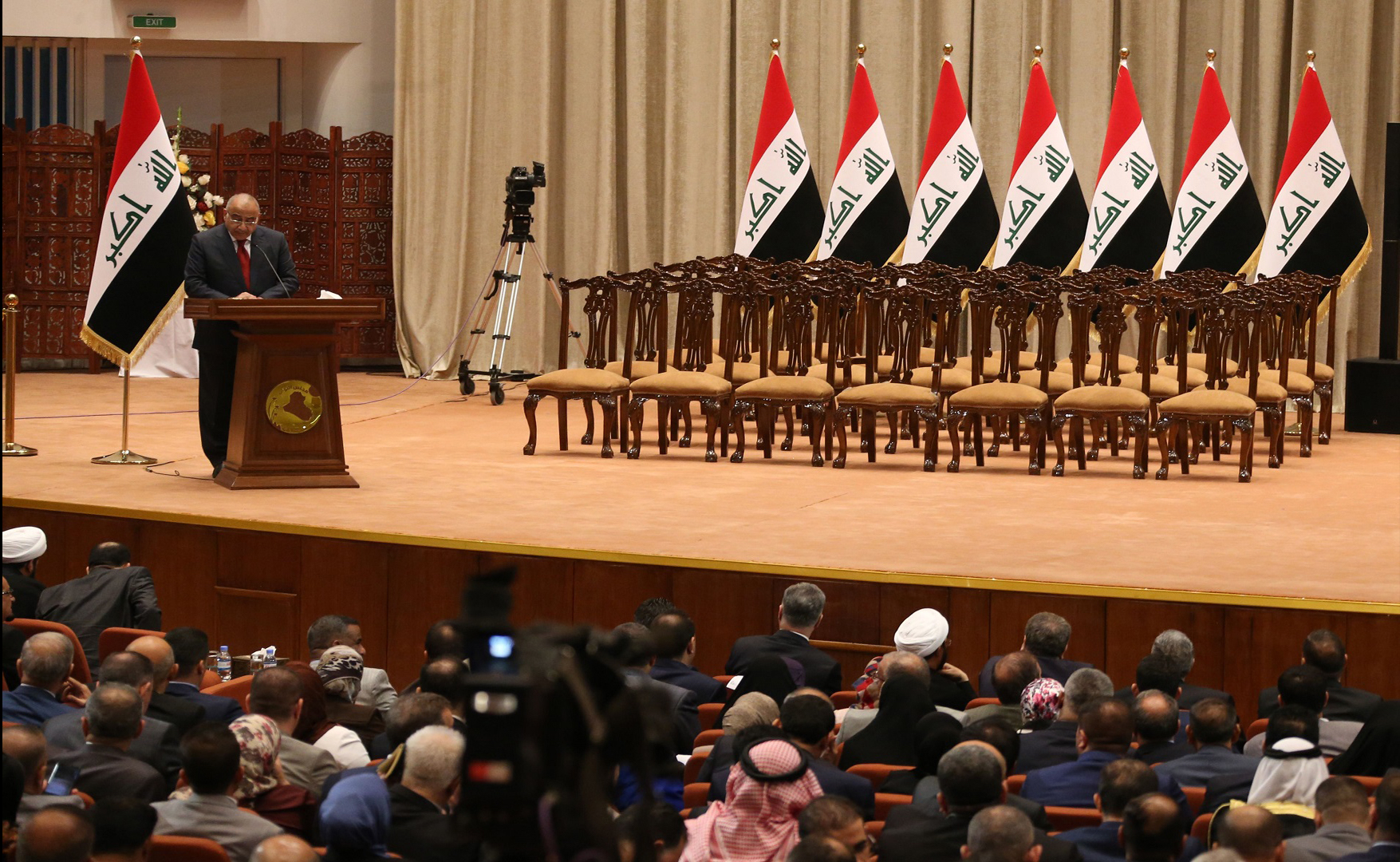
On Tuesday, 4th December, Iraqi Prime Minister Adil Abdul-Mahdi was unable to pass any of his candidates for the eight remaining ministerial posts following a failed vote in the Iraqi Parliament. In late October, the Iraqi Parliament approved 14 ministers to Mahdi’s cabinet. The remaining eight positions were originally due to be voted on in November, but divisions within parliament over the nominations for the Interior and Defence Ministries had pushed the vote back to December. Abd al-Mahdi nominated Falih al-Fayadh and Faysal Jarba respectively for the roles.
The leader of the Sairoon Alliance, Muqtada al-Sadr, had previously asserted that he would only support a politically-independent technocrat for the two contested ministerial posts and stated his opposition to Fayadh’s nomination. Fayadh, who was the chairman of the Popular Mobilisation Units (PMU) and a former national security advisor, was nominated by the Bina’a bloc, headed by Hadi al-Amiri.
In response to Mahdi’s decision to nominate Jarba and Fayadh, MPs belonging to the Sairoon Alliance, the Nasr Coalition and the Hikma Movement, boycotted the vote. The Patriotic Union of Kurdistan (PUK) also led a boycott of the vote in protest of not receiving any cabinet nominations. The cross-party opposition meant that despite Mahdi’s efforts to elicit support in the morning before the vote, the legislature only achieved a very narrow quorum of 168 achieved (quorum is 165) thus allowing the session to go ahead. However, the session quickly descended into chaos as members of the Sa’iroun Alliance objected to the session being held, saying that quorum had not been reached. This reportedly led to a physical altercation breaking out between several members in the Parliament, which delayed the session by half an hour before the Speakership announced that the session would be delayed indefinitely.
However, late on Wednesday 5th December, Abd al-Mahdi met with President Barham Salih and Speaker of Parliament Mohammed al-Halbousi to discuss changes to the eight nominees that were presented to Parliament on Tuesday. During Wednesday’s meeting, the three leaders agreed to delay the vote on the nominees until Sunday. Furthermore, reports suggested that the three have agreed to make a number of significant changes to the current list of nominees. According to reports, Salih, Mahdi and Halbousi want the leader of the Fatah Coalition, Hadi al-Amiri, to agree to replace Falih al-Fayyadh with Ahmad al-Asadi, the spokesman of the PMU, as the nominee for the Interior Minister position. These reports were later contradicted by Zahra al-Bajari, a MP for the Bina’a bloc, who said that the bloc is unable to give an alternative to Falih al-Fayyadh as Minister of Interior as the Prime Minister himself is insistent on his nomination for the post. This supposedly explains why Abd al-Mahdi refused to change his choice of nominee for the Minister of Interior position despite the likelihood that it would not have been passed in parliament due to the overwhelming opposition to Fayyadh.
The inability of the Iraqi Parliament to reach a consensus on the nominations for the completion of Abd al-Mahdi’s cabinet has prompted concerns within Iraq over the government’s incapacity to stabilise the country as the decision over the two key security ministries remains in deadlock. In Basra, protests have continued to escalate with reports that dozens of protesters attacked the convoy of the Iraqi Finance Minister, Fuad Hussein. Footage released on social media shows a number of protesters kicking and hitting vehicles in the convoy, with others chanting slogans and telling the officials. The recent developments in Basra are a testament to the lack of progress made in the province as protestors continue to repeat the same demands made in the summer. Resolving this issue and lessening tensions in the province will be a significant challenge for the government and could undermine Abd al- Mahdi’s administration.
For more information on this subject and other developments in Iraq and Syria, subscribe to our daily intelligence reports and weekly digests.