

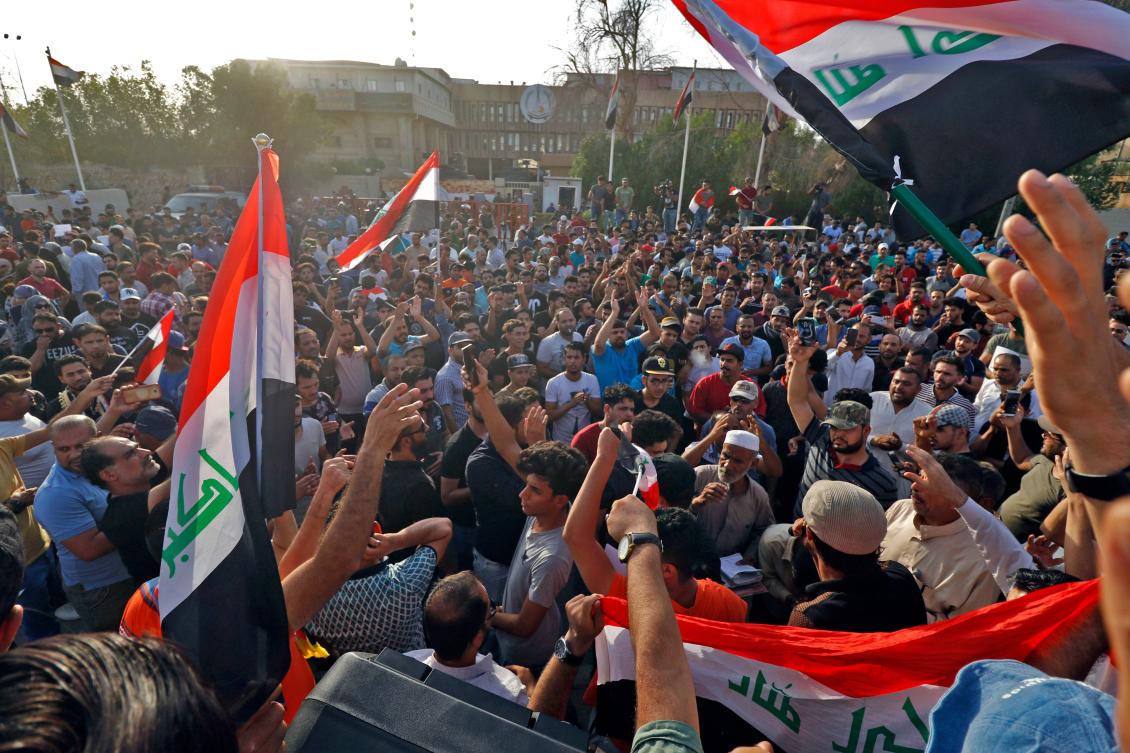
On Sunday the 8th of July, the southern oil-rich province of Basra witnessed mass demonstrations, with protestors demanding jobs, electricity, water and other essential services. A protest in West Qurna district in Basra resulted in the killing of at least one demonstrator and the injuring of eight, which amplified preexisting tensions with the security forces. The Iraqi police claimed that the security forces intervened to prevent protesters from blocking a road leading to oil companies operating in the area.
However, oil officials confirmed that Sunday’s protest did not have any impact on the security or operations in the oilfields.
By Thursday 12th of July, protests had metastasised into the southern provinces of Wasit, Maysan, and Dhi Qar.
As a result, the Iraqi Prime Minister, Haider al-Abadi, cut his trip to Brussels short and arrived immediately in Basra Province to assess the situation. The PM acknowledged the demands of the protesters and their right to protest the state of public services and unemployment, however, he also suggested that some groups within the demonstrations are carrying a political agenda.
On Friday 13th of July, clashes were reported between protesters and security forces in some areas around Basra, resulting in the killing of three and the injuring of at least seven people, including a security officer. The clashes led to a number of foreign workers being evacuated by helicopter from Lukoil’s headquarters in the province.
Later that same day, Ayatollah Sistani’s representative, Sheikh Abdul Mahdi al-Karbala’i, said that the country’s main religious authorities (Marja’iyyah) express their solidarity with the demands of the demonstrators in Basra. However, he called on the protesters to not attack or vandalise state institutions in the provinces.
Despite this call by Iraq’s Highest Shi’a authority to not destroy state institutions, by Sunday 15th of July, the protests in the south resulted in the damaging of at least 28 public and political institutions including the Najaf airport and the offices of Kata’ib Hezbollah, Dawa Party, and al-Hikma movement.
This led to the dispatching of units from the Counter-terrorism Services (CTS) to the southern provinces to prevent public and private institutions from further vandalism, and the shutting down of the internet to prevent the further spread of rumours and false reports
By Monday 16th of July, the chiefs of police in Najaf and Karbala were sacked due to the poor handling of the security situation in their respective provinces. Amidst this decision, protests are ongoing in the southern provinces and Baghdad.
For more information on this subject and other developments in Iraq, read our daily report.