

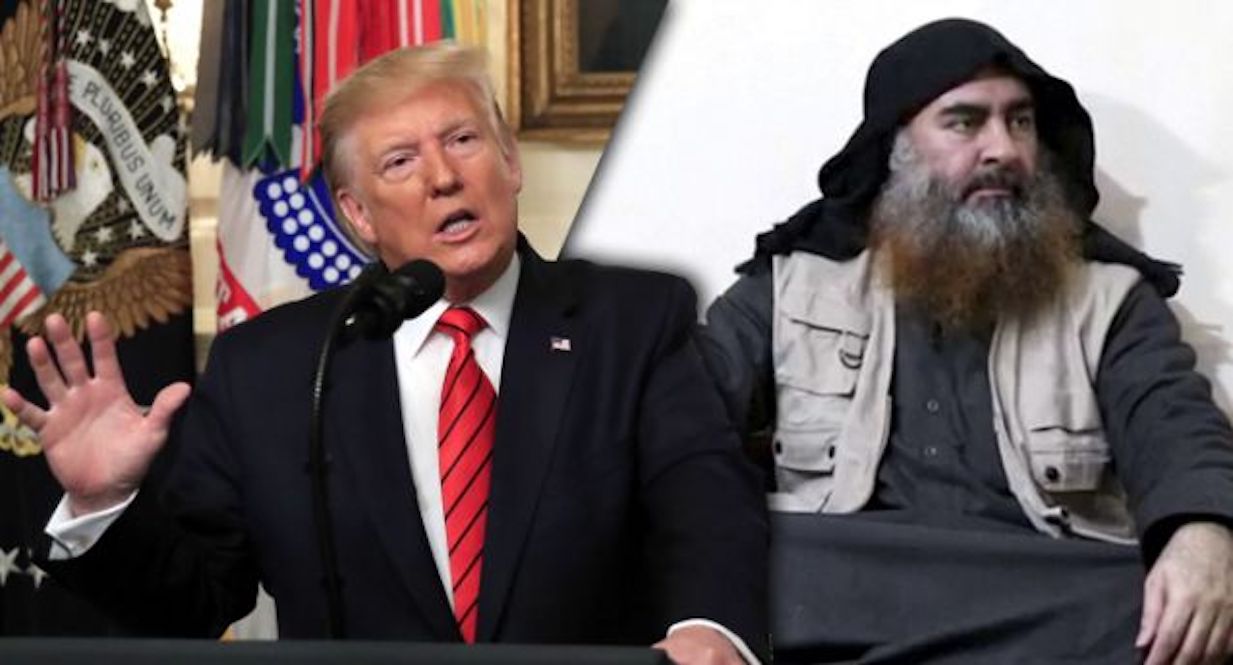
On Saturday, the United States’ President, Donald Trump, announced that the leader of the Islamic State (IS), Abu Bakr al-Baghdadi, was killed during a Special Forces raid at a safe-house in Idlib. By most indications, he was located in a compound near the village of Barisha in Idlib. Among those killed in the operation were his deputy, Abu Said al-Iraqi, and Abu al-Yaman, the head of the group’s security in Syria. Curiously, a commander of Tanzim Hurras al-Din (THaD), Abu Mohamad al-Halabi, was also killed during the raid. Shortly after Baghdadi’s death, the IS’ spokesperson, Abu Hassan al-Muhajir, was also killed by an airstrike while in a vehicle near Jarablus.
Baghdadi’s death represents an important inflection point in the fight against the IS. Although not the founder, Baghdadi has nevertheless been a pivotal figure for the group, having ruled over it when it declared a Caliphate and took over large parts of Iraq and Syria. With additional franchises in Libya, Afghanistan, and the Philippines, Baghdadi has remained a powerful symbol for the IS and its aspirations of creating a Caliphate.
As such, his death represents a major blow to the morale of IS supporters around the world who were invigorated by his most recent video and voice messages. His death, as well as the deaths of his deputies, will prevent the group from replacing him quickly and easily. Indeed, highlighting the uncertainty about who is to lead the group next, there have been a number of statements, allegedly from the group’s Amaq news agency, proclaiming the group’s new leadership. Each one of those, so far, have been proven to be false. With much of the group’s top leadership dead, arrested or being targeted, low and mid-level commanders will likely try to gain eminence or otherwise prove themselves capable of leading the group. As a result of this, as well as in a bid to prove that the group remains a force to be reckoned with, cells around the world will try to launch attacks against the group’s enemies. Already, some 27 people were arrested in Turkey, allegedly planning to launch a “spectacular” revenge attack.
It should be noted that although Baghdadi was a powerful figure, he did not rule by personality alone. The group has a fairly coherent ideological and operational doctrine. Members and militants of the group will likely fall back on these doctrines in a bid to keep the group and its franchises around the world coherent. However, in the absence of a strong central guiding figure that inspires loyalty and emergent theological fractures that Baghdadi at points held together, it is likely that the many franchises will drift apart and the group may eventually splinter.
One interesting factor here is how al-Qaeda and Hayy’at Tahrir al-Sham (HTS) will react. Supporters of both groups were jubilant at the death of Baghdadi whose actions instigated what came to be known as the “greatest divorce in the Jihadi world”. However, the fact that a commander of the THaD – a group affiliated with al-Qaeda – was present in the compound with Baghdadi raises questions about whether the wider al-Qaeda network was aware of Baghdadi’s whereabouts. It is possible that the two groups were looking to reconcile their differences in the face of common threats. In any case, both al-Qaeda and the HTS may seek to “redeem” and recruit surviving IS militants, especially if the group experiences a protracted leadership contest. With Baghdadi – a highly-polarising figure within the Jihadi world – no longer a factor, the groups may even seek to reunite with each other. However, this will be a difficult task given their propensity for factionalism.
Meanwhile, it will be important to keep the pressure up on the group’s cells while also ensuring that the next generation of militants are not able to keep the flame of the IS’ and Baghdadi’s goals alive. There is already a risk that the group may take advantage of the current protests across Iraq and the security vacuum in northern Syria borne out of the Turkish operations against the Syrian Democratic Forces (SDF). In Ain Issa, hundreds of militants were able to escape following heavy fighting in the region. And Al-Hol Camp, where a majority of IS women and children are kept, has been especially volatile. The IS supporters there have had free reign in keeping the group’s violent ideology alive, raising the children there to be loyal to the Caliphate. The window to de-radicalise these children is closing in and fast. Many such children had no say in the decisions their parents made – or in some instances, when they were forcefully abducted from their parents by the militants – and leaving them to grow up as militants not only denies them a chance at normal life, but risks creating a core population of stateless IS supporters with nothing to lose.
Questions must also be raised about the circumstances in which the operation took place and where Baghdadi was located. A number of observers have already raised concerns that Baghdadi was just a few kilometres from the Turkish border. Similarly, Abu Hassan al-Muhajir was in Turkish-controlled Jarablus – allegedly dealing with smugglers to secure safe passage for Baghdadi – when he was killed. Although the Turkish Ministry of Defence indicated that it coordinated with the US Special Forces, a report in Newsweek, citing insiders, claimed that US officials did not inform Ankara about the operation. Some observers have even claimed that Turkey was harbouring Baghdadi deliberately. This, of course, cannot be confirmed. However, it is evident that a number of IS militants have been able to slip under the radar in Turkish-controlled areas. Indeed, a number of activist groups have catalogued the presence of IS supporters in these areas. In the coming months, it will be important to find the causes behind the intelligence failure that led to Baghdadi finding refuge in an otherwise-hostile Idlib, while also understanding how he got to Idlib from Raqqa or Deir ez-Zour where he was traditionally based.
For more information on this subject and other developments in Iraq, subscribe to our daily intelligence reports and weekly digests.