

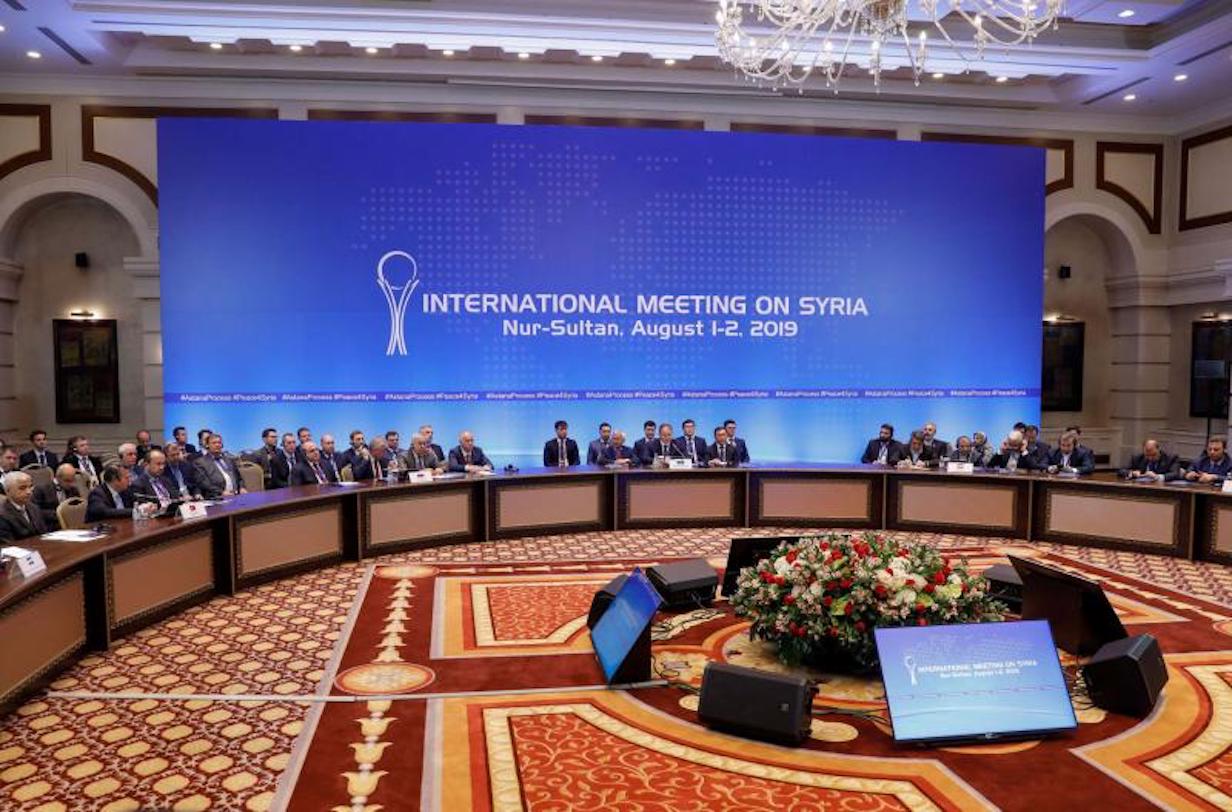
Last week, delegates from a number of countries, including the Syrian guarantor countries of Turkey, Russia and Iran, met in the Kazakhstan capital, Nur-Sultan (Astana) for the 13th round of the Astana Peace Talks on Syria. Among the main points discussed at the talks included the security situation in Idlib, eliminating the presence of militant groups in the region and making progress towards the launch of the Syrian Constitutional Committee (SCC).
Following the talks, a joint statement released by the guarantor countries last Friday, 2nd August, expressed “satisfaction with the progress made on the finalisation of the composition and rules of procedure” of the SCC. A ceasefire in Idlib was also announced, which stipulated that all parties in the region abide by the memorandum signed last September, which included the withdrawal of medium and heavy weapons in a 15 to 20 kilometre-wide de-militarised zone (DMZ) in the rebel-held province.
In response to the announcement of the ceasefire, the Syrian Arab Army (SAA) stated that it would wait until the end of Eid al-Adha (starting on Sunday 11th August) for rebel and militant groups to withdraw from the DMZ. However, Jaber Ali Basha of Ahrar al-Sham (now part of the National Front for Liberation (NFL)) announced that his group would not withdraw its heavy weapons. Similarly, Abu Mohammed al-Jolani, the leader of the militant coalition Hayy’at Tahrir al-Sham (HTS), announced that his group would reject the ceasefire unless it included the SAA’s withdrawal from the regions of northern Hama that it had captured since April 30th.
Despite initial optimism towards the ceasefire with the arrival of Eid, shelling and gunfire exchanges took place last weekend around southern Idlib and northern Hama, albeit without any airstrikes taking place. On Monday 5th, however, the SAA issued a statement in which it accused opposition factions in Idlib of violating the terms of the ceasefire and announced an end to the ceasefire agreement. Since then, the region has witnessed increased artillery fire, as well as numerous airstrikes.
Although a return to the conditions of the ceasefire may still be possible, its inability to last until now is the latest in a number of failed attempts to stop hostilities in the region following the decision to implement a DMZ at the Sochi summit almost one year ago. Indeed, since the agreement, both the Syrian Government and Russia have largely placed responsibility for the implementation of the DMZ on Turkey. As a result, the SAA and its allies have been reluctant to withdraw from the region fearing a pre-emptive attack. Turkey, for its part, has struggled to balance its own interests, and that of its allies in the region, with the presence of HTS, which is not a party to the DMZ agreement but maintains control over much of Idlib.
The failure to implement the Idlib DMZ until now is symptomatic of the Astana Peace Process’ inability to agree on the more precise details behind its agreements. Indeed, immediately following last September’s DMZ agreement there was some confusion over the exact location of the DMZ, which Turkey and its allies insisted should be shared between territory controlled by both the SAA and the NFL. This ambiguity towards agreements continued last week, with Russia’s Special Envoy to Syria, Alexander Lavrentiev, admitting that the guarantor countries had not focussed on the precise terms of last week’s ceasefire during the talks. As a consequence, the terms of ceasefires, in addition to the broader peace process, are often left to be decided on the battlefield, with all sides reluctant to agree to anything that could harm their interests.
The next round of talks is set to take place in September, during which the guarantor countries will begin to set the terms of the United Nations-sponsored SCC. However, for the conference and the constitutional process to be a success, each party to the talks will need to move beyond setting indistinct conditions on the Peace Process. For this to work, the guarantor countries, in addition to the Syrian Government, will need to be prepared to make a greater number of concessions to avoid continued conflict in northern Syria.