

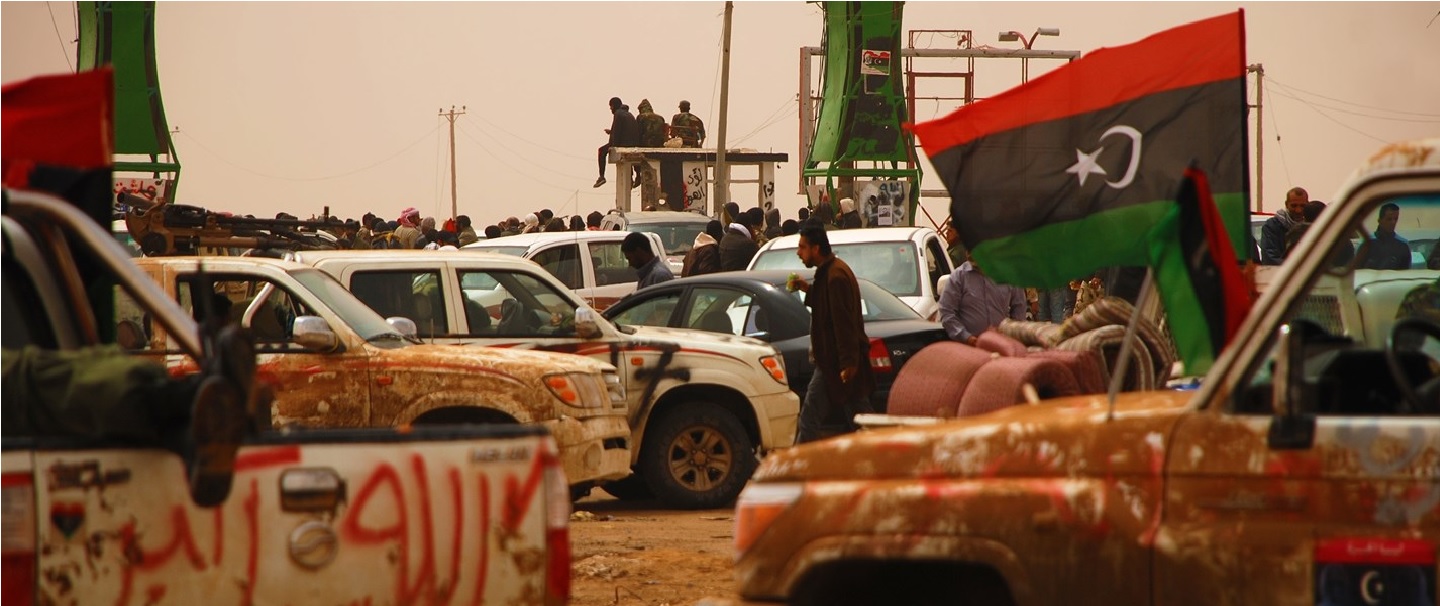
It has been nine months since Khalifa Haftar, the leader of the self-styled Libyan National Army (LNA), launched an all-out offensive against Tripoli, where the country’s UN-recognised Government of National Accord (GNA) is located. Affiliated with another of the country’s governments, the Tobruk-based House of Representatives (HoR), Haftar proclaimed that this phase of the fighting would be the “decisive battle” to wrestle away control of the Libyan capital.
By all accounts, Haftar had all the advantage, having been slowly and steadily consolidating control across Libya, including the oil crescent. The GNA, meanwhile, has been hampered by a poor economy, flagging services and near-constant militia infighting.
Yet Haftar’s offensive galvanised the GNA-affiliated militias and what should have been a swift offensive to capture the country’s capital turned into a stalemate, with the GNA and the LNA repeatedly fighting over the same stretch of land on the outskirts of the city. Given the stalemate that has gripped the frontlines, it is unsurprising that many observers regarded Haftar’s recent announcement of the final phase of the operations with scepticism.
But the scepticism has overlooked a number of developments taking place in the country, including growing foreign involvement.
On the GNA side, observers have noted increased deliveries of military hardware, including Turkish-made Kirpi (Porcupine) armoured vehicles and Bayraktar (Flagbearer) drones, the latter which has turned Turkey into a major global player in the field of drone warfare. In conjunction, Turkey has also increased its political involvement in the country. Turkish President, Recep Tayyip Erdoğan, met the GNA’s Prime Minister, Fayez al-Sarraj, last Sunday and pledged to support the GNA. The two sides also signed a controversial agreement for military cooperation and an agreement delimiting the maritime border between Turkey and Libya. Erdoğan, who has been consistently supportive of the GNA over the years, did not dismiss the notion of deploying the Turkish Armed Forces (TSK) in Libya to protect the GNA.
On the other side, the LNA’s arsenal of Chinese-made Wing Loong drones has recently been bolstered by newer hardware and even personnel amidst rumours of the Russian private military contractor Wagner increasing its presence. GNA fighters have noted that LNA attacks have become more precise in recent weeks, allowing the group to slowly wear down the GNA-affiliated forces around Tripoli. Although Moscow has kept its distance from Haftar over the course of much of the conflict, rumours of Russian support for the LNA, which also receives support from France, Egypt, Saudi Arabia and the United Arab Emirates (UAE), has picked up in recent weeks.
While there has been a long-standing geopolitical component to the Libyan conflict, the LNA’s concerted efforts to capture Tripoli have pulled these dynamics further into view. For Turkey, considering the admixture of geopolitical and ideological interests, supporting the GNA may be one of its only avenues to retain support in the MENA region following the ousting of Mohammed Morsi in Egypt and the gradual decline of the Syrian Opposition, all of whom have ideological commonalities. Indeed, both Haftar and the current President of Egypt, Abdel Fattah al-Sisi, have expressed major ideological opposition to Erdoğan and his allies. Similarly, the involvement of UAE and Saudi Arabia reflects the growing hostility between Turkey and the Gulf, excluding Qatar, which has joined Turkey in its support for the GNA.
In this context, Russia appears to be emerging as a sort of kingmaker in Libya. In Syria, Moscow was able to partner with Ankara to manage the conflict despite the two sides supporting opposing factions. Although fighting in Idlib continues, it has shifted far from the free-for-all that defined the earlier days of the war and military offensives have become very localised. Turkish-held parts of northern Syria, meanwhile, are virtually safe from any military offensive and have become a safe-haven for the Syrian Opposition.
With Erdoğan increasingly in contact with the Russian President, Vladimir Putin, over the situation in Libya, there is a possibility that a similar dynamic may emerge. Although the dynamics in Libya are different from those in Libya, Moscow and Ankara are once again backing opposing factions while looking for ways to cooperate. Indeed, Ankara likely finds Moscow an agreeable partner due to the latter at least appearing willing to abide by Ankara’s concerns, especially in situations where doing so would damage the interests of the United States or pull Turkey further away from NATO’s orbit. With a precedent for cooperation already existing in Syria, there is room for the two sides to manage, if not end, Libya’s conflict. Such an option is even more plausible given that unlike Syria, Moscow already has economic and political ties with the GNA, making the conflict less insurmountable.
On the other hand, involvement in Libya may expose the differences between Ankara and Moscow all the more. Erdoğan has spoken about Wagner and the wider Russian involvement in Libya with great hostility. Erdoğan’s announcement of sending the TSK to Libya also came after he discussed the matter of Libya with Putin, suggesting a potential impasse between the two leaders. Erdoğan’s comments, as well as the maritime agreement between the Turkish Government and the GNA also received a hostile response from Moscow.
These aforementioned claims hinge on the influence that these geopolitical players have on local actors on the ground. The ever-shifting balance of financial, military and material backing provided by Turkey and Russia is likely to determine the outcome of future political negotiations that seek to form a united Libyan government. Political efforts in this vein that have been organised under the auspices of the United Nations Support Mission in Libya (UNSMIL) have thus far led to a series of stalemates, with the LNA attempting to gain as much military advantage on the ground as possible before seriously entering any power-sharing negotiations, wherein Haftar aims to stand in a higher bargaining position. The question is just how far are the aforementioned geopolitical players ready to maintain their geopolitical interests in Libya? And whether their efforts will help bring about an end to the conflict or perpetuate it even further?