

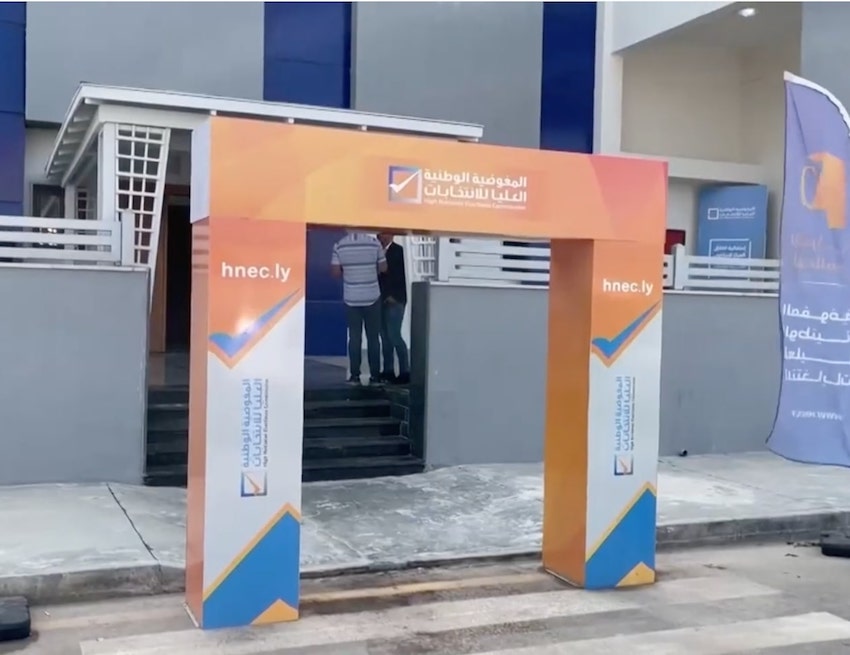
There are growing calls in Libya to delay the general and presidential elections due to take place on December 24th. Those calling for the delay warn that the pre-election instability is increasing to such an extent that letting the polls run as scheduled could do the country more harm than good and potentially risk a return to war.
In this article, we assess the current socio-political environment in Libya against the backdrop of the upcoming elections. At its current juncture, both holding and delaying the elections carry considerable risks. However, holding the elections as planned on December 24th may be the only opportunity to continue a path towards a peaceful resolution to Libya’s conflict, whilst delaying the elections themselves could serve as a conflict trigger. Furthermore, there is little likelihood that the country’s institutions will be able to address all the issues that plague the pre-election environment.
Despite this, Libya has already experienced the deeply-destructive effects of a rushed and ultimately-delegitimised election in 2014 and can ill-afford a repetition of that. Splintered institutions in the country are making small but notable progress towards unification and a delay of a couple months may allow this process to continue, allowing Libyan officials to address some of the concerns around the election as well as addressing institutional deficiencies that have already caused delays in the final announcement of the candidates.
Background to the 2021 Election
The upcoming election has its roots in the Libyan Political Agreement, a peace process that was implemented after the United Nations brokered a ceasefire in the aftermath of 14 months of fighting around Tripoli. With the main sides, the Tripoli-based Government of National Accord (GNA) and Khalifa Haftar’s self-styled Libyan National Army (LNA) stalemated, a resolution to the conflict appeared to be within reach. The agreement saw the formation of a new interim government, the Government of National Unity (GNU), and the designation of election dates – both general and presidential – set for 24 December 2021.
At the onset of the announcement, there were already concerns that premature elections could threaten the already fragile peace process. Such concerns were rooted in numerous realities: security in the country was still largely in the hands of militias loyal to local power brokers; the country’s institutions were divided, sometimes violently, between those loyal to the GNA in Tripoli and those loyal to Haftar and the House of Representatives (HoR) in Tobruk; and, that deep mistrust remained between the two sides.
Such concerns were bolstered by the history around Libya’s conflict, which itself was triggered by the 2014 elections that took place under deep security concerns, institutional unpreparedness, and competing sources of power and legitimacy. All of these factors contributed to the low participation of 18% of eligible voters and, ultimately, the violent contestation around the results.
The Election Race Gets Underway
It was clear from the onset that the elections would test the limits of Libya’s weak institutional capacities. 98 candidates registered for the presidential race while another 5,385 candidates registered for the parliamentary elections.
Despite such challenges, the election process appeared to be off to a good start. With initiatives such as the “Libya Decides” process, Libya’s High National Elections Commission (HNEC) sought to showcase the candidates to the public. Furthermore, some 83% of the voters had already received their voting cards by the start of December. Furthermore, the security situation had remained broadly stable, with insurgent attacks or militia infighting at a relative low.
However, the situation soon deteriorated. The challenges that come with a crowded playing field were further compounded by the controversial nature of some of the candidates. Among such candidates was Khalifa Haftar and Saif al-Islam Gaddafi, the son of the deposed Libyan leader Muammar Gaddafi.
Gaddafi and Haftar’s candidacies had immediate polarising effects. Political factions across the country launched appeals against other candidates, including Haftar and Gaddafi. Although as many as 20 candidates were rejected due to being in violation of Article 10 (past criminality) and Article 11 (dual citizenship), Haftar and Gaddafi were not among them. Indeed, the appeals process against Gaddafi turned particularly violent, with his counter-appeal in Sabha blocked by militias loyal to Haftar who were accused of threatening the judges presiding over the decision.
Haftar’s appeals process, meanwhile, showcased the diffused nature of Libya’s institutions, with competing courts issuing contradictory decisions. For example, an attempt by the Zawiya Appeals Court to ban Haftar from the presidential race was blocked by appeals courts in Tripoli and Sabha, with the HNEC itself seemingly unable or unwilling to put its foot down.
The situation worsened in the days since. Over the course of December, footage emerged of militias attacking HNEC offices in Tripoli; news emerged of polling stations around the country being robbed, with voting cards stolen. Since then, the frequency of security incidents rose sharply, with December 14th witnessing both clashes in Sabha and an assassination attempt on a GNU military commander.
Another source of pre-election instability was the resignation of the UN Special Envoy to Libya, Jan Kubis, who did not give a reason for his surprise announcement on November 23rd. However, it has been widely speculated that his decision is related to election-related tensions behind the scenes.
Through it all, the HNEC has yet to issue a final list of the candidates.
It is therefore unsurprising that numerous high-ranking officials, including the chair of the UN Security Council and the Libyan High Council of State (HCS) have all advised postponing the elections until at least January 2022, using this time to reach a unified and coherent decision around candidates and to ensure election security.
What are the Possible Scenarios?
As a country with competing centres of power, widespread militia governance, endemic corruption, and general polarisation, neither holding the elections nor postponing them offers a solution to Libya’s troubles.
Proponents of holding the elections on December 24th argue that these issues have been present in Libya since Gaddafi’s downfall a decade ago. Successive efforts to unify the country’s competing centres of power, clamp down on militias and reduce corruption have not yielded far-reaching results precisely because the country’s power brokers are those who have benefited from these conditions being in place. An election, in this sense, offers a way to turn a fresh page with how the country is governed, allowing some kind of consensus for the future of Libya.
Furthermore, the fact that the UN was able to broker a ceasefire in the aftermath of bitter fighting could be seen as an indicator that the Libyan conflict is ripe for a resolution, that for better or worse, all major Libyan factions are on-board with the idea. If the election is delayed and new talks over the election process is launched, it could cost the small and admittedly-imperfect window Libya has for peace through a democratic process. It could convince the warring sides that military victory is the only solution. The delay could further give opportunities for spoilers and other actors to make plans to disrupt or hijack the election.
Even failing that, the delay may give opportunities to less legitimate actors to make plans to disrupt, spoil or hijack elections.
However, the opposite is also the case. Should elections be held in a deeply insecure and polarised environment, their legitimacy will suffer greatly. Citing robberies of election cards and politicised judgements, the losers will almost certainly have the means and motives to discredit election results and contest them, violently if need be. Indeed, the lack of electoral legitimacy was one of the causes of the clashes that erupted after the 2014 election.
Such a risk of spoilerism is especially high where Haftar or Gaddafi are concerned. Many opponents of Haftar and Gaddafi fear that Libya would slip back to the autocracy it once was before 2011 should either of these men be elected. Indeed, militia leaders in Misrata have already threatened violence against their candidacy. Should either of them win the Presidency, the country would almost certainly face a new civil war.
A Cause for Optimism?
Given that both outcomes could push the country into new conflict, one might be hard-pressed to conclude whether there is any point in holding the elections at all. In this context, developments in other sectors could be a guiding principle. Indeed, a number of positive institutional developments suggest that Libya could benefit from not rushing the elections.
Among such developments are the meetings held by Libya’s 5+5 Joint Military Committee. The committee, made of senior military officials from both sides of the country, met with Turkish and Russian officials to discuss the withdrawal of foreign mercenaries that arrived in Libya to bolster the GNA and the LNA respectively. Although both sides have yet to actually withdraw their forces, they have reportedly reacted positively to the roadmap presented by the Committee.
Similarly, officials from Libya’s Central Bank, which was divided between Tripoli and Tobruk, held meetings in December to unify the institution in order to service the whole country. Similar talks over the unification of the National Oil Corporation (NOC) also yielded some success despite the NOC being at the heart of militia infighting over the rentier revenues to be made.
These are surely modest successes, but they are indicative that efforts to build nationwide trust and a coherent institutional framework may continue.
The 2014 elections in Libya, as well as other, similarly-rushed and polarised elections in post-invasion Iraq have shown that elections held under low-risk, high-insecurity conditions have deeply deleterious effects. They create conditions in which election results can be contested based on misinformation, and brute force always remains an option.
A delay of a month or two will not be able to address all these challenges. However, it may serve to reduce the heat around the elections, as well as counter the growing sense of pessimism around it by addressing a number of pressing concerns. And with Libya already living with the consequences of a rushed election, the road not taken may be worth a consideration.