

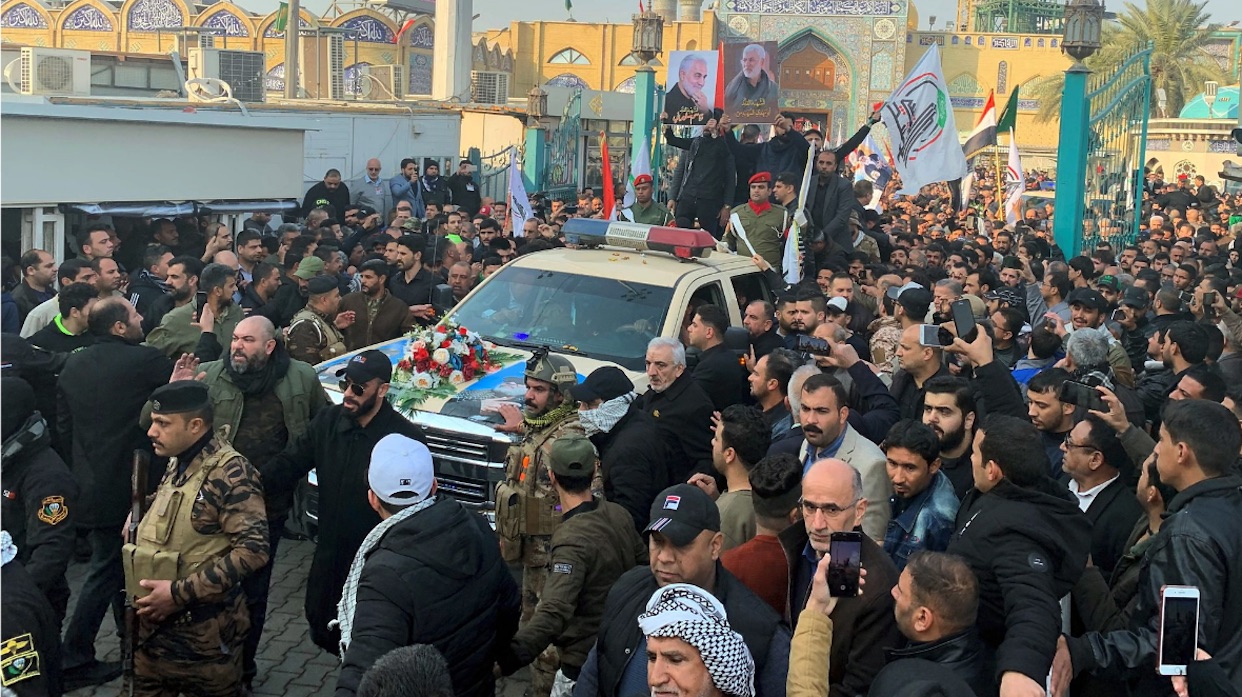
On the early hours of Friday, the United States conducted a drone strike that killed the head of the Iranian Islamic Revolutionary Guard Corps’ (IRGC) Quds Force, Qassem Soleimani, as well as the deputy head of the Popular Mobilisation Units (PMU), Abu Mahdi al-Muhandis.
The strike, which was by all accounts planned and executed by the US with full knowledge of who was being targeted, sent shockwaves around the world. As the person responsible for the Quds Force, Soleimani was in charge of Tehran’s extraterritorial activities in Yemen, Syria, Iraq, Lebanon, the Palestinian territories and elsewhere. In doing so, his actions often brought him in conflict with the US which viewed him as one of Washington’s most dangerous adversaries in the region. Others, such as the Syrian Opposition and some elements of the protest movement in Iraq, viewed him as the architect of the suppression of the protesters in these countries, as well as the brutal urban warfare seen in Syria. His death was therefore celebrated by all these actors who viewed Soleimani as an extension of Tehran’s own regional influence.
Much has been said about whether the strike, marking one of the most direct examples of escalation during the years-long US-Iran tensions, will improve or worsen security in the Middle East. Indeed, Washington’s own narrative was that the death of Soleimani has made the region and the US safer.
This narrative, however, was contested by those who suggest that Soleimani’s death will trigger a series of tit-for-tat attacks and retaliations that may lead to an all-out-war. Already, Tehran has threatened retaliation for the attack while Washington has been reinforcing its forces across the region. Furthermore, a substantial act of retaliation is vital for Tehran to both display that it honours the memory of Soleimani, who was often called a “living martyr” and viewed as the paragon of the Islamic Republic’s ideals, and to show that it remains effective, capable and undeterred by Soleimani’s death.
However, at present, the breakout of a war benefits neither side. Iran, despite gaining greater influence on the ground in the region and modernising its own military, is struggling economically and has been experiencing violent protests. Although a war against Iran’s “Great Satan” would be a powerful rallying cry, the outcome is far too unpredictable for Tehran to push for war. In Washington, the US President, Donald Trump, has been accused of stoking the conflict to bolster himself politically amidst on-going tensions surrounding impeachment. However, Trump has often rallied around the notion of avoiding another war in the Middle East. Indeed, this is one of the most consistent modes of behaviour he displayed over the years. Perhaps highlighting this, both sides have bolstered their escalatory rhetoric with de-escalatory or clarificatory statements concerning their positions.
Given this, as well as Tehran’s past history of acting calculated and pragmatic when the need presents itself, it is likely that Tehran will continue to empower its proxy groups and political partners to disrupt or damage the US’ interests in the region, but in a manner that reduces its enemies’ motivation for a counter-strike. The recent announcement to roll back some of the commitments of the long-struggling Joint Comprehensive Plan of Action (JCPOA) appears to have been intended as such a response, although this is a plan that is not yet as completely moribund as the headlines suggest. However, with so many factors present in a highly-volatile region, the room for error and the potential for misreading the situation is extremely high.
Furthermore, the mode of operation of the IRGC has often created contingencies for decapitation strikes. The IRGC ensures that its allies are ideologically committed to Tehran but is otherwise willing to grant them significant autonomy. As a result, the institutional and operational capacities of IRGC-affiliated factions are unlikely to be harmed in the short-term. Indeed, unbound by Tehran’s own calculations, these factions may conduct their own acts of retaliation that can inflame tensions more than Tehran’s own direct actions.
Two countries, in particular, stand to be impacted particularly heavily. The Iraqi case is obvious, given that the strikes, as well as the chain of events leading to the strikes – such as the supporters of the PMU-affiliated Kata’ib Hezbollah attacking the US Embassy in Baghdad – took place in Iraq. Since the strike, Baghdad has strengthened its calls for the US to withdraw from the country, citing violations of its sovereignty. While many Iraqis are sceptical of Iran, they are also highly sceptical of the US. The Iraqi protest movement, which has been going on for months, has been critical of both the US and Iran. However, in performing direct strikes on prominent Iraqi figures and disregarding the concerns around the sovereignty of Iraq, this has effectively thrown away what little good will Washington had left. Tehran will almost certainly seek to take advantage of this situation, working to push the US out of Iraq even if itself suffers short-term costs in the process. If need be, Iran will likely compel the PMU factions loyal to it to make life harder for the US forces in the country.
In Syria, the situation equally volatile. Although Damascus is wholly allied with Tehran, it doesn’t have too much direct influence in the country’s east, in Deir ez-Zour and Hasakah provinces, where the US forces are present. IRGC-affiliated militias are highly present there, especially around Albu Kamal and the risk of those groups attempting to target the US forces or its Syrian Democratic Forces (SDF) allies are extremely high. The IRGC and the SDF have already been experiencing tense relations despite Moscow’s attempts to mediate peace between them and all the region needs is a spark to escalate. Furthermore, suspected US and Israeli airstrikes have repeatedly targeted the IRGC in the area.
Such a spark needn’t come from the IRGC or the SDF. Groups such as ISIS have proven themselves adept at conducting false-flag attacks to get its enemies to fight one-another. With so much mistrust and uncertainty, it wouldn’t be a difficult task for the group. The risk of ISIS-linked attacks is further exacerbated by the announcement that the International Coalition in Iraq and Syria is suspending its anti-ISIS operations to focus on securing its bases and troops against Iranian-linked attacks.
One possible course of reducing tensions may come from Qatar which offered to mediate between Iran and the US. Qatar is notable in that unlike the rest of the Gulf states (excluding Oman), it has carefully managed its relations between the US and Iran, often ‘zigzagging’ between them depending on the context and situation. Furthermore, it has a history of conducting mediation between US and its enemies, having hosted talks between Washington and the Afghan Taliban. The country also has significant sources of soft power over the MENA region through its network Al Jazeera. While neither Washington, nor Tehran have accepted the offer so far, the room for backchannel diplomacy is present.
With the situation still highly fraught, especially as the international community awaits a potential response from Tehran and the US’ threats to sanction Iraq, diplomatic de-escalation must be sought by all means possible. Despite being allies of the US, EU countries in addition to countries like Qatar and Oman, have the ability to mediate between the US and Iran. Over the past few days, many world leaders have expressed fear of military escalation between the two countries. With increased pressure from world leaders and the UN, the ramifications of the assassination may be minimised. Otherwise, this tit-for-tat battle may play out in the region for decades to come.