

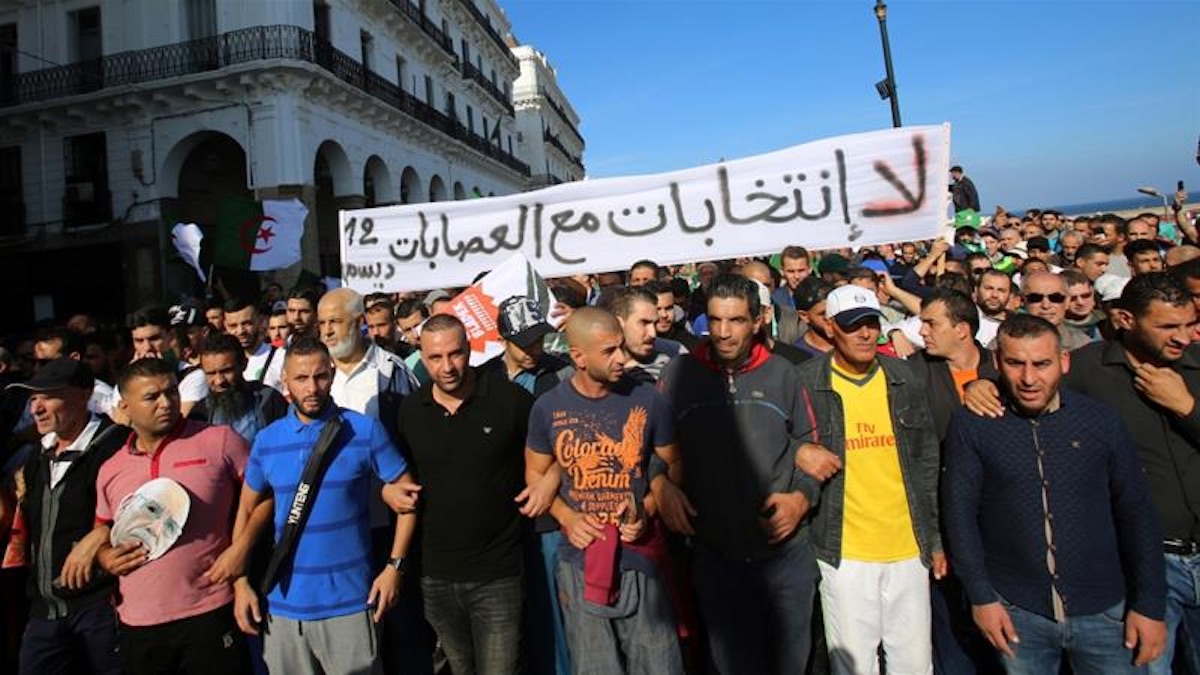
In early November, the electoral authority in Algeria announced the five candidates (Abdelmadjid Tebboune, Ali Benflis, Azzedine Mihoubi, Abdelkader Bengrine and Abdelaziz Belaid) who will be competing in the presidential elections set to take place on 12th December. These candidates include two former Prime Ministers, a former Culture Minister, a former Tourism Minister and founder of El Moustakbel Front, who also served as a deputy for a decade under the National Liberation Front (FLN), the ruling party in Algeria since independence from France.
All the above-mentioned nominated individuals have links with the former regime in one way or another, going against the protesters’ vision of an Algeria free from nepotism and clan rule. Hopes for a new Algeria were at an all-time high when the former long-ruling leader of the former regime, Abduleziz Bouteflika, was forced to resign in April as a consequence of continuous protests that broke out in February. Although Bouteflika succumbed to popular pressure, he was effectively sacrificed by other influential political figures who then took his place, mainly from the military elite. The figure who has effectively been leading the country since the fall of Bouteflika is the country’s Deputy Minister of Defence, Ahmed Gaid Salah, who had been appointed chief of staff of the People’s National Army by Bouteflika in 2004 and has been the kingmaker in the country’s politics since Bouteflika’s ousting.
The attempts to continue the political status quo in Algeria has prompted protesters to persevere in their demonstrations week in week out. Since the announcement by acting head of state Abdelkader Bensalah in September that presidential elections will take place at the end of the year, the anti-election protests have been unrelenting. Protesters are convinced that the elections are a façade that the establishment is using to entrench its rule in the post-Bouteflika era. Students, lawyers, judges, civil rights and human rights activists have joined forces in voicing their grievances on the streets, as part of a protest movement now known as “Hirak”. The security forces have responded with arrests and at times low-level violence. Nevertheless, the discipline of the protesters has prevented them from succumbing to provocations from the authorities, who have frequently labelled the demonstrators as “gangs” and portrayed them in a negative light.
The unified will of Algerians manifested in the persistent and disciplined protests that have been ongoing since February can be explained by a number of factors. Protests that broke out across the MENA region during the so-called “Arab Spring” led to a number of cases where disunity in the face of an authoritarian state led to civil war, namely in Libya and Syria. And in the case of Egypt, a long-standing dictator, Hosni Mubarak, was deposed by popular will and replaced by Mohamed Morsi, who was eventually removed from power and replaced by the military establishment, represented by Abdelfattah al-Sisi. Protesting Algerians are keen to avoid these precedents of civil war and military rule. The experiences of Tunisia and, currently, Lebanon, demonstrate the power of a unified, peaceful protest movement in affecting genuine political and social change.
Furthermore, Algerians themselves have a painful history of civil strife that is still very much ingrained in the popular memory of the country. A civil war that lasted over a decade during the 1990s claims tens of thousands of lives, sometimes in gruesome circumstances. The political splits and external players involved in stoking up tensions that exploded in the 90s have since faded away. Those participating in Hirak are aware of Algeria’s past and of the experiences in other Arab countries, and so they are focused on maintaining peaceful unity in the face of the establishment.
The establishment has nevertheless made attempts to convince the public that it is on their side. Anti-corruptions campaigns began in June when individuals linked to the automobile manufacturing industry were detained and charged with moneylaundering. In September, a military court had also sentenced the brother of the former president, Said Bouteflika, in addition to a number of other figures with links to the Bouteflika regime, to prison. More recently, corruption-related trials were launched against former political figures, including two former prime ministers, Ahmed Ouyahia and Abdelmalek Sellal, who have now been sentenced to lengthy prison terms. These trials were publicised with an eye to demonstrate to the public that the establishment is actively pursuing corrupt individuals.
Yet protesters remained unconvinced. The silencing of protest voices by the authorities and threats made against those taking an anti-election stance, in addition to the nomination of presidential candidates linked to the former regime have proved to protesters that the establishment in transition is not on their side. Pro-government forces, mainly represented by the General Union of Algerian Workers (UGTA), linked to the FLN, made their voices heard at the end of November as they attracted a crowd representing a fraction of Hirak.
A nationwide strike was announced on social media outlets on 8th December. Protests were even witnessed among diaspora Algerians living in France, who are also eligible to vote. The preponderance of the protest movement and anti-election sentiments portend a low turnout on 12th December. The foreseeable lack of legitimacy of the post-election government will lead to a period of instability, wherein the protest movement is likely to continue making its demands, while the establishment attempts to hold on to the political levers it has taken control of. The future of the country will depend on the dynamics between the protest movement and the establishment in the formation of a political culture in the post-Bouteflika, or, as some hope, a post-FLN era.