

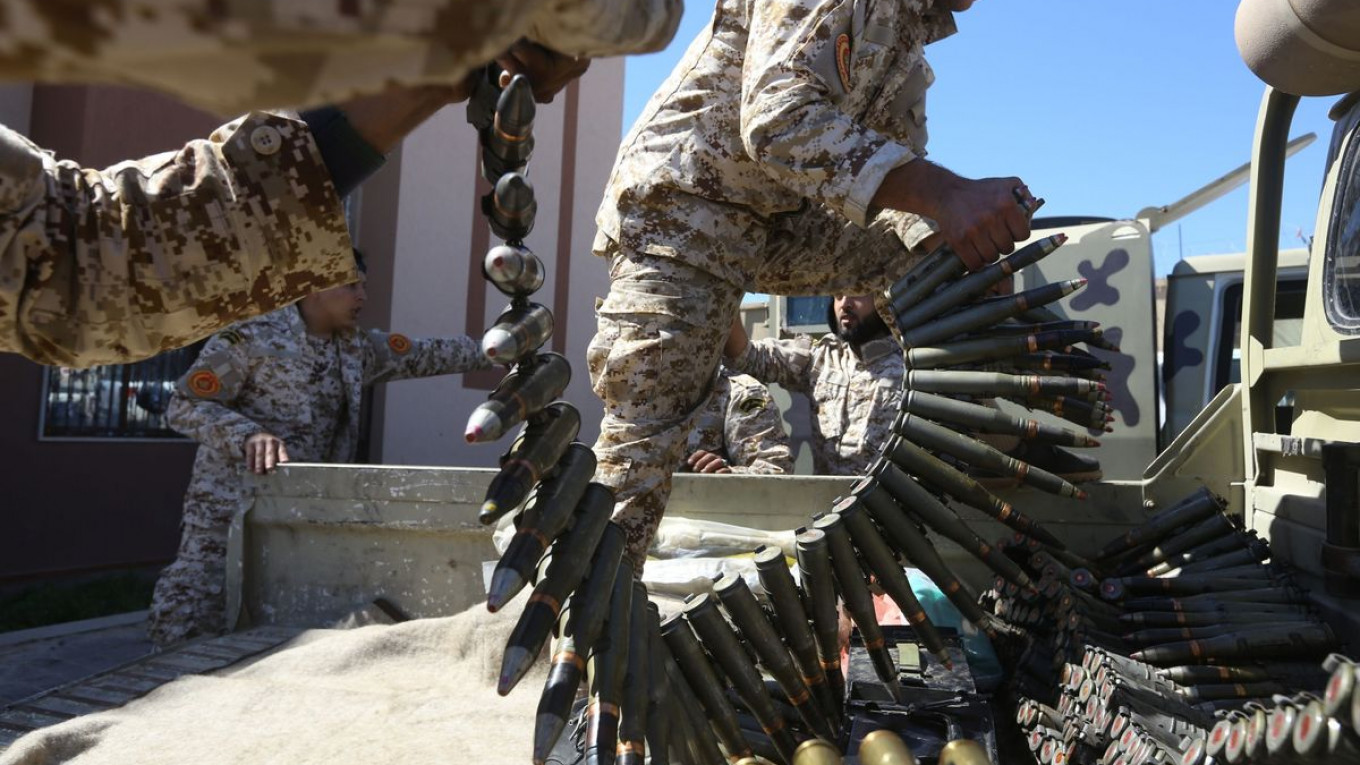
Fighting in the Libyan capital of Tripoli continues to intensify following the failed implementation of a two-hour humanitarian truce on Sunday 7th. The temporary ceasefire, which was negotiated by the United Nations’ Mission in Libya (UNSMIL) towards the end of last week, sought to enable the evacuation of civilians caught up in the intensifying clashes in the southern and western suburbs of the city. The humanitarian crisis in Tripoli worsened over the weekend and into the beginning of this week as militias loyal to the Tripoli-based Government of National Accord (GNA) launched their counter-offensive against the Libyan National Army (LNA) led by the Field Marshall, Khalifa Haftar and affiliated with the Tobruk-based House of Representatives (HoR). Meanwhile the LNA, which made significant gains following the initial launch of its offensive last week, has lost several positions around the Tripoli International Airport, leading to fears of a protracted battle.
The LNA’s offensive in Libya’s capital city is the latest development in its three-month campaign to seize control of Libya’s southern and western desert regions. Despite conducting its mission under the guise of a security operation, its advance had enabled the LNA to gain control of Libya’s second-largest oilfields, Sahara and el-Feel. Having previously secured Libya’s largest oilfield in 2016, the Sirte Basin Oilfield, its advance into western Libya effectively handed a monopoly of Libya’s oil production to the LNA and the HoR. Since then, Haftar used the prospective oil rents to co-opt numerous rival militias and tribal groups into the LNA, allowing for a rapid push north towards Tripoli. The LNA and its local backers have attempted to cut Tripoli off from the west by seizing control of the highway leading to the Tunisian border. In response, the United Nations-backed GNA, which has no organised military, has drafted in militias from Sirte to assist in defending the city.
An emergency meeting convened last Friday by UN Secretary-General António Guterres between Khalifa Haftar, commander of the LNA, and a GNA representative failed to produce an agreement for the cessation of hostilities and a return to immediate negotiations. Later in the day, the UN Security Council released a joint statement condemning the escalating conflict and called on all sides to agree to a ceasefire. An earlier proposed motion that would have singled out the LNA as an aggressor was blocked by Russia, a key backer of the HoR, which insisted that all parties to the conflict be viewed as equally responsible. Indeed, the international divergence over Libya has been key to its inability to push for a political solution to Libya’s conflict. Russia, France, the United Arab Emirates and Egypt support the HoR due to its claims of opposing Islamist militias despite incorporating numerous Salafist militias under its own umbrella. Nevertheless, domestic priorities have often shaped the outcome of previous summits, such as those held in France and Italy last year.
At a summit held in Abu Dhabi in February, the GNA were forced to negotiate from a weaker position than ever before having recently conceded the loss of the Sahara and el-Feel oilfields. Despite this, little was achieved following the talks apart from an agreement to hold an additional summit starting this weekend (14th to 16th April). It is commonly viewed that the LNA’s ongoing offensive in Tripoli is intended to pressure the GNA ahead of these talks, with Haftar, perhaps, hoping for a greater role for the HoR in the UN-backed Libyan Political Agreement. Indeed, the fact that there has been no indication towards the talks being cancelled or postponed supports that both sides remain open to negotiations.
If this is the case, however, the stalled LNA offensive on the edges of Tripoli and the renewed GNA counter-attack, now including the highly-trained and well-equipped Misratan militias, could lead to a drawn out battle that leaves no winners and contribute further to the deterioration of the fragile stability in Libya.