

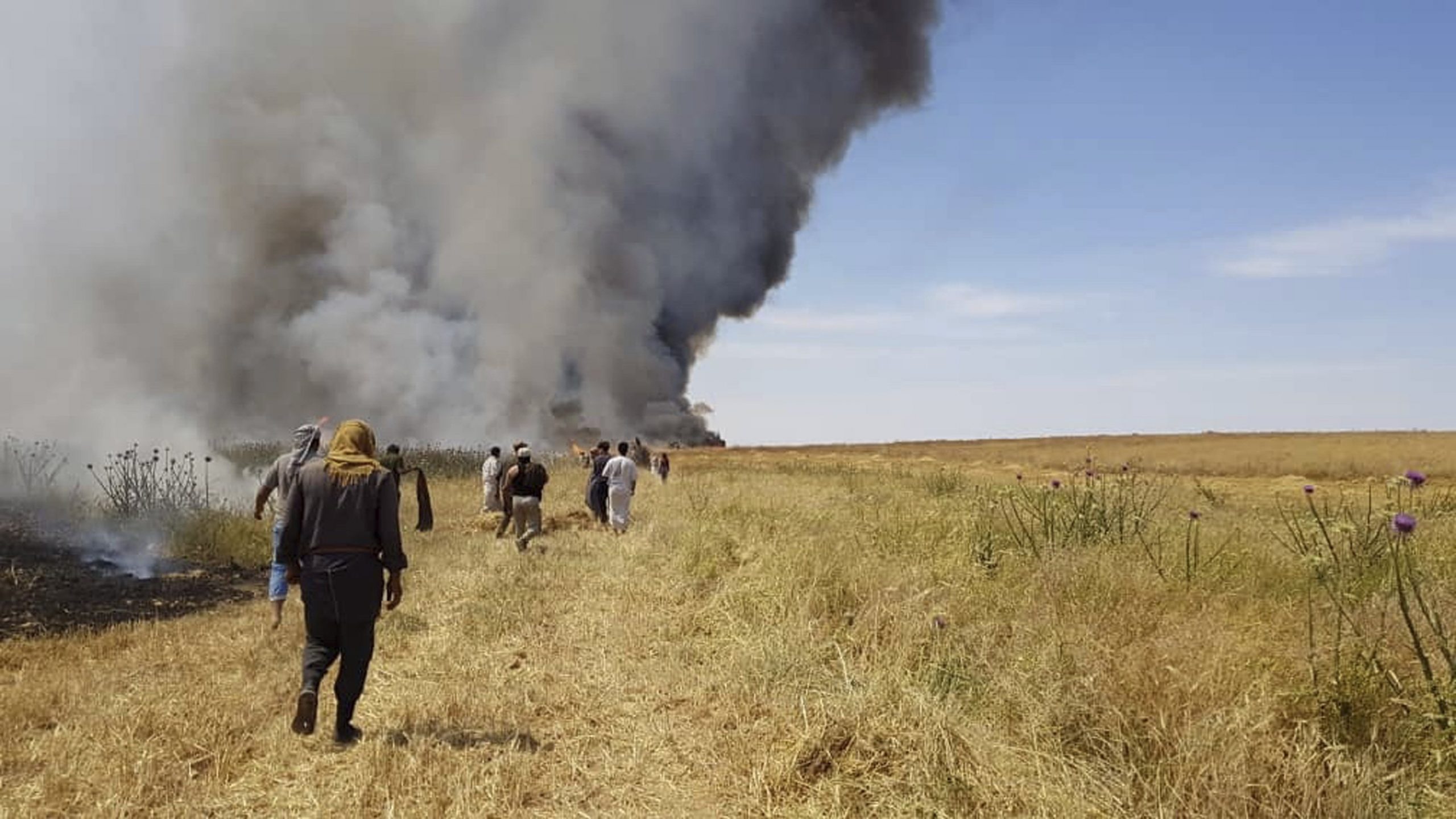
ISIS insurgents operating in north-eastern Syria and northern Iraq have claimed responsibility for a series of crop fires over the past month, which have targeted wheat and barley crops shortly before their harvest at the start of the summer. Since the beginning of May, an estimated 20,000 acres in Syria and 134,000 acres in Iraq, or 1.6% of Iraq’s total wheat and barley output, has been destroyed
The crop fires have come as farming communities in both countries prepared for their first harvest in more than a decade that was neither impeded by war, nor the drought that affected north-eastern Syria and northern Iraq between 2006 and 2010. Indeed, there is some evidence to suggest that in 2008, the worst year of the drought for Syria, the dramatic reduction in agricultural output prompted some communities to temporarily migrate to Syria’s major economic cities in the west of the country. This migration, which occurred simultaneously with the global financial crisis, precipitated growing frustration with Syria’s stagnant economy and, consequently, the Syrian Government. In Iraq, the draught conditions in Nineveh that decreased living standards and incomes before 2014 have all been exacerbated by ISIS’ use of scorched earth tactics – involving burning fields and woodland, and polluting wells – during its withdrawal in 2016 and 2017.
Indeed, the recent incendiary attacks are the latest manifestation of ISIS’ scorched earth strategy, which it has used to destroy infrastructure, agricultural land and water supplies across the militant group’s former territories. However, the latest attacks appear to have specifically targeted farming communities that had previously rejected ISIS rule, in addition to targeting farms in Nineveh that had recovered in the period following the defeat of ISIS in the region. This suggests that the ISIS leadership has continued to seek retribution against these communities and exacerbate economic hardship in the countryside of both Syria and Iraq.
ISIS’ use of crop fires could, therefore, have far-reaching social and political implications beyond the temporary loss of income suffered by farming communities. The rural poverty and food shortages resulting from the crop fires could provoke a crisis similar to that of 2008. Indeed, farming communities in both countries have already expressed their frustration with the inability of the security forces to contain the spread of crop fires, which have been further hindered by a lack of fire-fighting resources. In north-eastern Syria, officials from the SDF have called on the United States-led International Coalition to provide additional fire-fighting support, including through the use of helicopters, following the death of ten people last Sunday (16th June).
As ISIS returns to its roots as a countryside-based insurgency, the crop fires serve a strategic value for the militants in keeping the rural regions of both Syria and Iraq unstable and ripe for the group’s potential future re-emergence. Reports from a number of communities claiming that ISIS militants extorted money from them with the threat of starting fires reinforce these claims. As such, the protection of rural communities and the prevention of further crop fires should be viewed as a priority for the security forces of both countries. The failure of the SDF and the Iraqi Security Forces (ISF) to provide adequate security to rural communities will enable ISIS to achieve its objective of turning popular frustrations against the local authorities.
The fires also serve as ideal propaganda fodder not just for ISIS but all other sides involved in Syria and Iraq. Already, there have been numerous competing claims blaming the fires on the SDF, the International Coalition and other factions, with several videos – usually determined to be fake – posted online as “proof”. Such agitprop has not helped a region where the lack of trust cooperation between factions is already hampering the fight, as evidenced by the Syrian Democratic Council rejecting an aid offer from the Syrian Civil Defence, also known as the White Helmets. Past experience has shown that a deficit of trust between factions and authorities have served as the ideal breeding ground for ISIS.
As such, these on-going fires represent a challenge that, if left unaddressed, can be significantly detrimental to regional stability. Coming shortly after a winter of heavy flooding, this summer’s wildfires also raise questions on how equitable and sustainable reconstruction can be achieved amidst a global trend of increasingly extreme weather.
For more information on this subject and other developments in Iraq and Syria, subscribe to our daily intelligence reports and weekly digests.
Image: AP